
Directorate General of Customs: The foundation stone of the future headquarters will be laid this Tuesday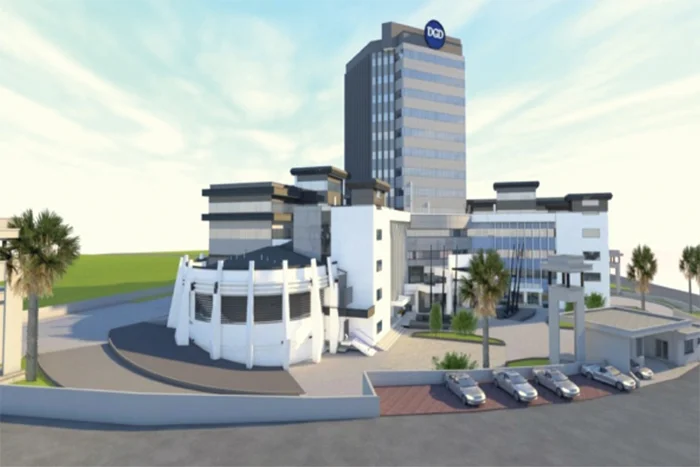
The construction of the future headquarters of the Directorate General of Customs is scheduled to launch this Tuesday, December 9. Louis Paul MOTAZE, Minister of Finance, will preside over the ceremony of laying the foundation stone.
OF WHAT USE IS A BUILDING?
For 2023, the DGD reportedly mobilised 1,019.8 milliards FCFA, surpassing the initial target (≈ 973.7 milliards) for that year.
For 2024, they collected ≈ 1,055.9 billion FCFA, a ~3.3 % increase over 2023, even though they did not fully reach the revised target of 1,094.9 milliards (completion rate ~ 96.5%).
The 2025 first-quarter results are strong: by that period, the customs revenues stood at ≈ 265.3 milliards FCFA, up 29 % compared with the same period in 2024.
Monthly data: for example, in January 2025, the DGD collected ≈ 95.33 billion FCFA, slightly above its monthly target.
The DGD has shown a rising trend in revenue mobilisation over the last few years, consistently breaking the 1,000-billion FCFA barrier, with an upward trajectory into 2025. This suggests improvements in customs collection, enforcement or compliance — which could reflect better institutional capacity, procedural reforms, more efficient operations, or stronger controls.
Revenue growth gives fiscal space. The rising customs receipts mean the state (and by extension DGD) has more resources, which could justify and support capital investments (new buildings, offices, facilities).
Modernisation may pay off. If increased revenue stems partly from improved customs operations (better controls, perhaps better systems), then building/updating infrastructure could further consolidate gains: better offices, more efficient workflows, more transparency, easier coordination.
Better institutional capacity potential for better governance. The consistent performance suggests DGD may be, at least in part, becoming more capable — which is positive if combined with reforms, oversight, and accountability.
The recent performance of DGD offers a reason to be optimistic: rising customs revenues suggest the institution has momentum, which — if well managed — could transform into tangible improvements (efficiency, capacity, reliability). However, because the gains rely heavily on port regions, there is no direct public data linking revenue growth to infrastructure improvements; structural risks (fraud, uneven performance, external shocks) remain, and it would be premature to assume that a foundation-stone (new building) will by itself guarantee major systemic improvements. It can help — especially if paired with reforms — but institutional integrity, transparency and equitable development across regions remain key
The infrastructure entrusted to the Chinese China Machinery Engineering Corporation (Cmec) Sarl will be carried out within 42 months (44 months for the services of project management and technical inspection). It could therefore be completed by 2029-2030, and will have cost about 23 billion FCFA.
At the new administrative district of Yaoundé (in the vicinity of the Palais d’Etoudi), a space of about 10,000 m2 has been made available for the construction of this building. This will include the construction of a main tower-shaped building, comprising 02 basements, a ground floor, 11 floors and a mezzanine; two wings connected to the main building, including 02 basements, a ground floor, 03 floors and a mezzanine; exterior fittings, including a guerrain, vehicle and pedestrian traffic, technical premises, a fence.
Two wings connected to the main building, including 02 basements, a ground floor, 03 floors and a mezzanine will also be built. Other exterior facilities, including a guard, vehicle and pedestrian traffic, technical premises, and a fence, are planned.
Beyond the offices, the future headquarters building of the General Directorate of Customs will be equipped with conference rooms of 200 and 500 places; a library; a museum; archive rooms; gyms; a canteen with kitchen and other adjoining rooms; a nursery; technical spaces; outdoor parking spaces;