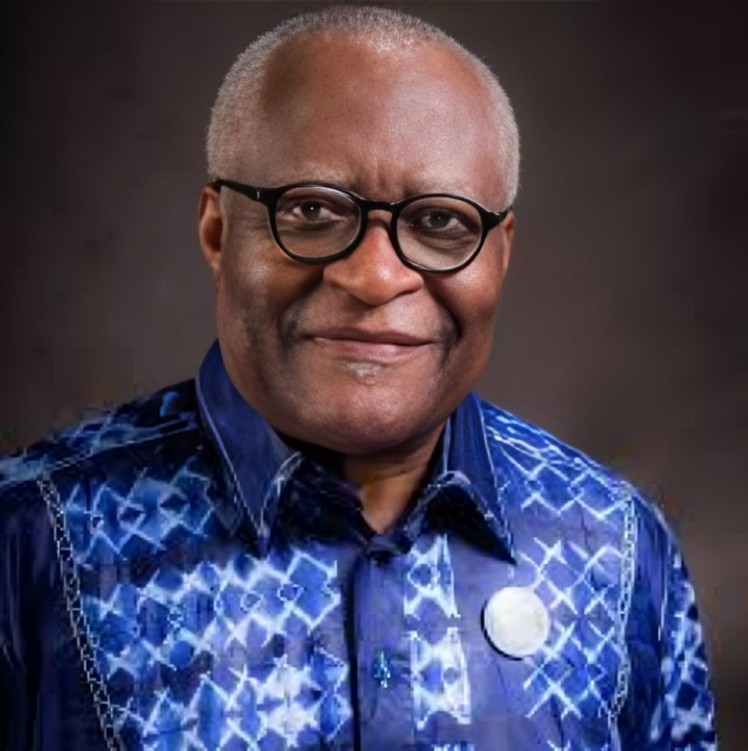

PUBLIC DECLARATION
by Barrister Akere T. Muna
On the purported collaboration between
Transparency International Cameroon (TI
Cameroon/TIC) and Cameroon’s National
Hydrocarbons Corporation (SNH)
I, Akere T. Muna, Founder of Transparency International Cameroon
(TI Cameroon/TIC), former Vice Chair of Transparency
International, former Chair of the Council of the International Anti-
Corruption Conference (IACC), Member of the High-Level Panel on
Illicit Financial Flows from Africa of the African Union and
International Consultant on Anti-Corruption and Good Governance
Governance, issue this public declaration in response to the serious
developments brought to my attention.
I have learned—through news media reports and through a publication
attributed to the Société Nationale des Hydrocarbures (SNH)—that
Transparency International Cameroon and SNH reportedly held a
strategic meeting on 26 February 2026, said to be part of an ongoing
“collaboration.” Yet, although I am the founder of TI Cameroon and
remain a member, I do not know whatsoever of any current
collaboration, nor of the framework under which it is taking place: its
objectives, governance arrangements, safeguards for independence,
reporting obligations, or any funding that may be involved.
I further recall that I was the initiator of Cameroon’s accession to the
Extractive Industries Transparency Initiative (EITI). In London in March
2005, when I was Vice President of Transparency International, with
the support of Dr. Peter Eigen, Founder of Transparency and the
commitment of Cameroon’s then Minister of Finance, Polycarpe Abah
Abah, Cameroon, publicly announced its adhesion. Transparency
International took the unusual step of congratulating Cameroon within
one hour of the announcement in the London plenary. Discussions—
including with Paul Boateng, then UK Treasury Secretary, who helped
facilitate the process, and Minister Abah Abah himself addressed the
plenary to make the announcement. Through these actions, I helped
secure a permanent seat for TI Cameroon on the National EITI
Committee, a seat TI Cameroon holds to this day.
It is therefore with particular concern that I see SNH publicly
associating itself with the name of Transparency International at a time
when SNH remains at the centre of grave allegations—indeed, judicially
recognized facts in multiple jurisdictions—concerning corruption and
opaque governance.
SNH and Cameroon’s national refinery, SONARA, have been referenced
in proceedings and judgments in the United Kingdom, the United
States, and elsewhere, as having received bribes in exchange for granting
preferential treatment to the Swiss commodities trader GLENCORE.
When I initially disclosed this information, SNH denied it, only later
acknowledging that there was an issue and eventually filing a complaint
against an unknown person. While GLENCORE paid major penalties in
several countries and was compelled to overhaul its leadership, SNH
has taken no credible corrective action—not even a basic internal audit
capable of identifying the senior officials to whom GLENCORE admitted
paying bribes.
SNH has also failed to provide a credible public justification for the
legal and commercial basis on which another trader, Vitol, allegedly
received a 70% discount. These matters demand transparency,
accountability, and reform—not public relations.
Beyond these scandals, the current governance of SNH appears to be in
profound disarray. The head of the company has reportedly not been
publicly seen or heard from for at least two years. Meanwhile,
information in the public domain suggests that the de facto leadership
may be exercised by the head of the legal department, now reportedly
serving as a technical adviser, who is the wife of the absent General
Manager. Yet SNH continues to sign contracts, including in partnership
with offshore companies and foreign entities, with little or no public
clarity regarding the role of the Board, the Chairman, the CEO, or even
whether regular Board meetings are taking place. Cameroon’s most
strategically important state-owned enterprise appears to be in a state
of institutional capture by a very small circle, at the expense of the
public interest.
In this context, when SNH boldly references its “cooperation” with TI
Cameroon—particularly in connection with the National EITI
Committee—one must ask: what is the true nature and purpose of this
relationship? Cameroon remains under suspension from the EITI,
largely due to persistent opacity in extractive sector governance. The
public cannot be asked to accept vague “collaboration” claims as proof
of integrity.
Accordingly, as a founder and member of TI Cameroon, I state the
following:
1. I formally dissociate myself from the purported collaboration between
TI Cameroon and SNH, as presented to the public, given the absence of
transparency about its framework, objectives, funding, and safeguards
for independence.
2. I denounce any attempt to sow confusion between Transparency
International (the Secretariat in Berlin) and Transparency International
Cameroon, which are separate and autonomous bodies in governance
and responsibility.
3. Based on the facts currently known, this initiative bears the
hallmarks of an attempt by SNH to obtain reputational cover—a form of
“anti-corruption washing”—without meaningful reforms, without
verifiable transparency, and without accountability for the GLENCORE
scandal and other serious governance concerns.
I also note, with deep concern, that TI Cameroon has not been
sufficiently proactive in relation to the GLENCORE/SNH corruption
scandal. The public has not seen a strategy commensurate with the
seriousness of these revelations—one that names the issues clearly,
demands accountability, and follows through. Combined with the
apparent opacity of the collaboration’s terms (objectives, funding,
deliverables), the risk is obvious: that the Transparency International
name is being used to legitimise a façade rather than dismantle secrecy.
To remove ambiguity and protect the integrity of TI Cameroon, its
members, and the Cameroonian public, I call on Transparency
International Cameroon to convene an Extraordinary General Assembly
without delay, open to its membership, with a clear, public, and
documented agenda to:
– State a clear anti-corruption objective with measurable outputs
for any engagement with SNH (beneficial ownership disclosure,
publication of contracts, audited financial statements, and anti-bribery
compliance, open procurement, EITI-aligned disclosures), with
timelines and public progress reports;
– Guarantee full independence, ensuring SNH does not influence over
TI Cameroon’s positions, publications, staffing, or priorities, and
that TI Cameroon retains full freedom to criticise SNH and
government publicly;
– Prevent compromising funding and conflicts of interest, including
full disclosure of any funds, strict ring-fencing, caps, and
enforceable conflict-of-interest rules;
– Ensure complete transparency of the relationship, including
publication of any MoU/terms of reference, funding sources,
minutes or summaries of meetings, deliverables, and progress
reports;
– Pair any engagement with enforceable accountability demands,
including calls for investigations, sanctions where warranted, asset
recovery, governance reform, cooperation with foreign authorities,
and identification of responsible officials to the fullest extent
permitted by law;
– Define clear exit and termination conditions, so that if SNH
refuses substantive reforms or uses the relationship for public
relations purposes, TI Cameroon ends the engagement and explains
why publicly.
This insistence on clarity is not abstract. It is not the first time that the
Transparency International brand has been targeted for its image
laundering. During the 2018 presidential elections, a purported team of
“Transparency International election observers” was later shown to be
made up of impostors. It also emerged that they had received some form
of one-day training by TI Cameroon—an episode that should have
resulted in heightened vigilance regarding the use of TI’s name and
credibility.
Let me be unequivocal: anti-corruption work cannot be outsourced
to those who benefit from secrecy, and the credibility of an anti-
corruption movement does not survive ambiguous arrangements.
Cameroon’s oil and gas resources belong to the Cameroonian
people. The public institutions that manage those resources must
be held to the highest standards of transparency and
accountability—especially at a time of oil-market uncertainty,
economic pressure, and growing public distrust.
I therefore call on TI Cameroon, on civil society, on investigative
journalists, on international partners, and on citizens to demand the
truth: the documents, the figures, the responsibilities, and the
reforms—not slogans and not staged photographs. History will judge
harshly those who, through silence, complacency, or calculation, helped
turn anti-corruption into theatre. Cameroon does not need the
appearance of transparency—it needs light. And light is not negotiable.
Yaoundé 05, March 2026
Barrister Akere T. Muna
PUBLIC DECLARATION by Barrister Akere T. Muna On the purported collaboration between TIC and SNH