
WHEN A FON BREAKS THE SHRINE, THE THRONE MUST ANSWER
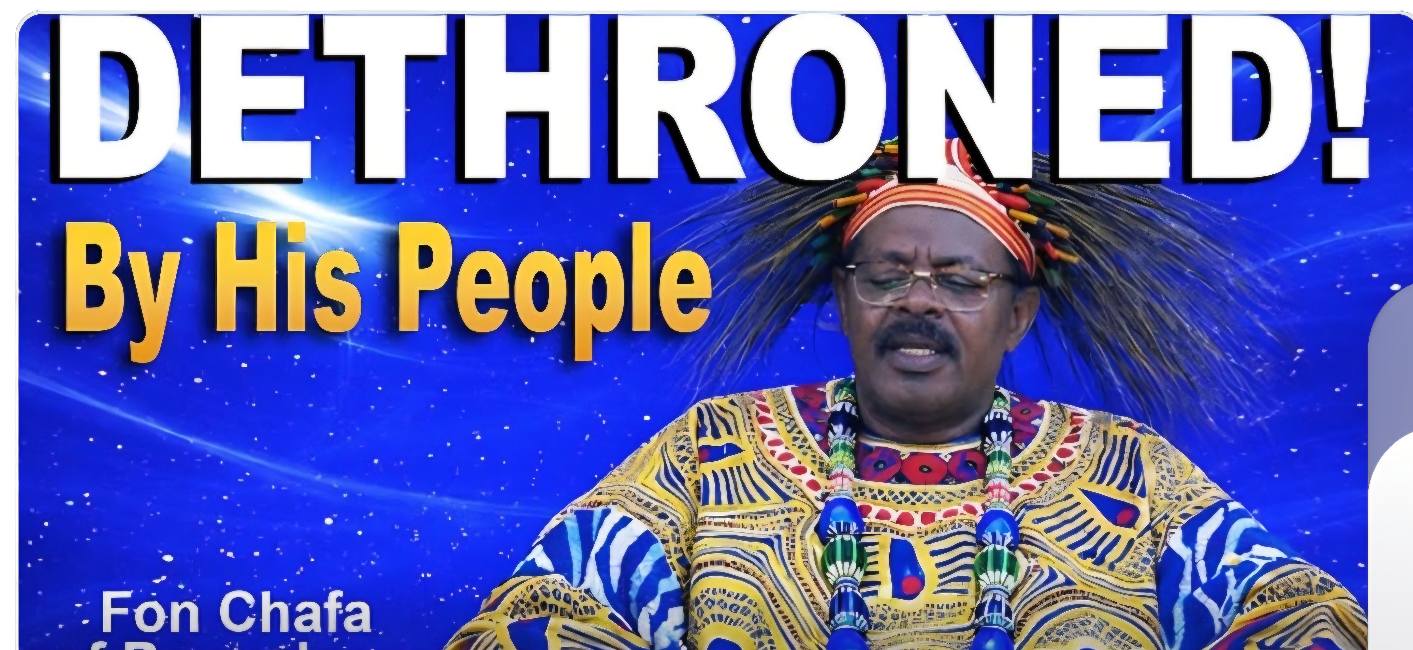
POSITION STATEMENT ON THE DETRONEMENT OF FON CHAFA OF BANGOLAN
I write this position in fairness and good faith, in my personal capacity, as a learned Prince of the Grassfields tradition, grounded in its anthropology, customs, and institutions, guided by conscience, tradition, reason, and faith.
In the Grassfields tradition of the North West Region, a Fon is not self-created. An institution makes him. The king makers act as custodians of ancestral authority, continuity, and sacred order. The same institution that enthrones a Fon also retains the traditional capacity to dethrone him when he unrepentantly commits an act that amounts to sacrilege.
The acts attributed to the dethroned Fon Chafa crossed a clear and fundamental red line in Grassfields tradition. By voluntarily presenting himself to a Christian cleric and requesting the removal of what he described as the ancestral spirit of Bangolan, he publicly renounced the very spiritual foundation upon which his authority as Fon rested. The removal of his cap, the laying of hands on his head, and prayers to remove that ancestral spirit were not private acts of worship. They were public acts of repudiation of the institution that created him.
More gravely, he later sent for the destruction of the traditional shrine of the Bangolan people in the name of taking out that spirit. In Grassfields cosmology, shrines are not symbolic ornaments. They are the spiritual anchors of the fondom. When a shrine is destroyed at the instigation of the Fon himself, the rupture between the throne and the ancestors becomes final. Such an act is traditionally irreversible. At that point, the Fon has effectively dethroned himself, leaving the king makers with a duty, not a choice, to restore balance by replacing him.
Refusing to let the decision of the kingmakers prevail would set a dangerous precedent. It would mean that a Fon’s personal beliefs, desires, or impulses can supersede the institution that created him. That precedent would not stop in Bangolan. It would cascade through other fondoms and undermine consistency, weaken authority, and erode the moral architecture of our traditions. Institutions survive only when they are stronger than the individuals who temporarily occupy them.
There is also a broader concern that cannot be ignored. The involvement of some Fons in partisan politics is a known taboo in Grassfields tradition. A Fon is expected to embody neutrality, unity, and service. The example set by the dethroned Fon Chafa has misled some Fons into open political alignment, greed, and materialism, shifting focus from service to personal accumulation.
It must be clearly stated, as a matter of fact, that Fons were long put on a salary after claiming recognition as auxiliaries of administration. That accommodation was meant to support dignity and service, not excess. In the case of Fon Chafa, the record shows multiple simultaneous sources of income. He received a salary as a magistrate. He received a salary as a Fon. He received remuneration as a Senator. He also received remuneration as Director of the Electricity Regulatory Board in Yaounde. These are four distinct sources of public salary for one individual alone, excluding what the community itself would have been providing. If a Fon chooses to claim all these benefits on the strength of the throne, yet proceeds to desecrate the very tradition that legitimizes that throne, it is only normal and just that the kingmakers replace him. He had the opportunity to relinquish some of these positions to deserving elites, but human greed would not allow it.
The argument that religious conversion excuses institutional betrayal does not stand, even on biblical grounds. Scripture is clear. Matthew teaches that no one can serve two masters. A Fon cannot claim ancestral authority while publicly renouncing the ancestral foundation of that authority. Luke warns that anyone who puts his hand to the plough and looks back is not fit for the work. One cannot abandon obligations while clinging to benefits. The book of Job shows that true submission to God involves surrender, not convenience. If one is truly born again, integrity demands letting go of offices and privileges rooted in what one now rejects. James further reminds us that leaders will be judged more strictly, not granted immunity.
If Fon Chafa truly believes he has been born again and now follows Jesus Christ, then the biblical path is clear. Like Job, he should be prepared to leave aside offices, privileges, and material attachments that contradict his declared faith. Christianity does not sanctify the retention of power obtained from a system one has spiritually denounced.
For these reasons, the decision of the kingmakers must prevail. It is not an act of vengeance. It is an act of institutional self-preservation. The throne is older than any occupant. The tradition is greater than any individual.
The conduct and outcome of Fon Chafa’s actions should stand as a lesson to other Fons who may be copying his bad example. The stool is sacred. It demands restraint, humility, and fidelity. When a Fon abandons these values, tradition has both the right and the responsibility to respond.
I therefore stand firmly with the authority of the kingmakers, not out of sentiment, but out of respect for continuity, coherence, and the dignity of the Grassfields tradition.

Awah Cletus Fobuzi