PRESIDENT JOHN F. KENNEDY OPPOSED THE DISMANTLING OF THE FEDERAL REPUBLIC OF CAMEROON
THE FRENCH MASTERMINDED THE DISMANTLING OF THE FEDERAL REPUBLIC OF CAMEROON AND THE EAST CAMEROON AND WEST CAMEROON ARRANGEMENT.
The United States, under President John F. Kennedy, opposed this move and strongly encouraged maintaining the federal system. Kennedy believed a federal structure would keep Cameroon whole and peaceful, recognising that self-interest and greed often take centre stage in politics and society.
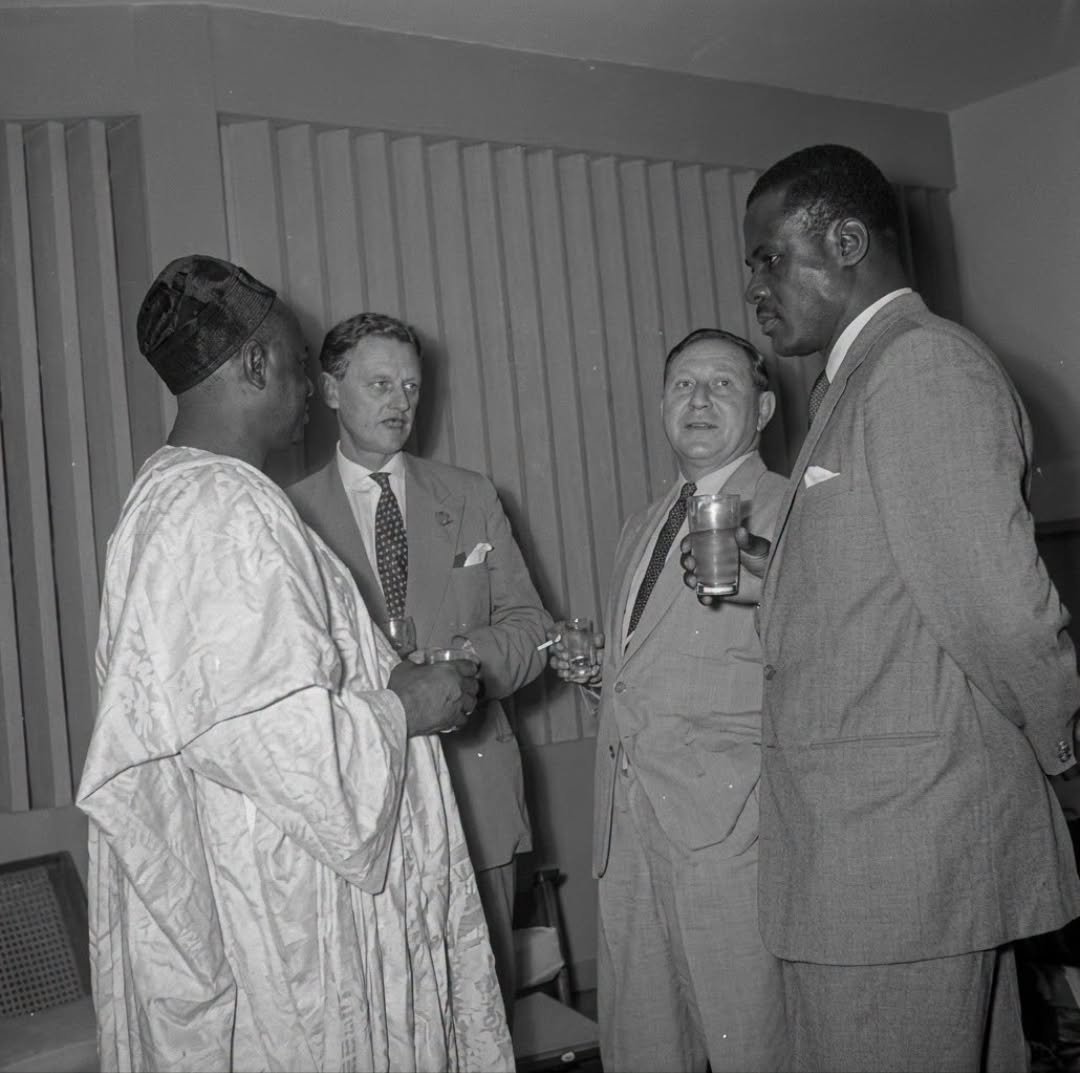
During a dinner organized by President Kennedy for this historic visit, President Ahmadou Ahidjo, who attended as Kennedy’s guest alongside several diplomats, was brought together with key international figures. In the picture below, you can see President Ahmadou Ahidjo alongside his collaborator, His Excellency Solomon Tandeng Muna, with two French diplomats.
It was during this period that the seeds for the current crisis in English-speaking Cameroon were planted. President Ahidjo was informed of the vast oil reserves in the Gulf of Guinea that drew competing interests from the French, the British, and the Americans. While keeping the federal structure would have been more favourable to the people, ensuring that revenues were shared equitably based on the agreement of two equal states, political ambition shifted the outcome. President Ahmadou Ahidjo and the French needed a side man and a foot soldier.
H.E. Solomon Tandeng Muna, who was there to represent the English-speaking minority of West Cameroon, aligned himself with President Ahidjo out of his own hunger for political relevance. Meanwhile, President Ahmadou Ahidjo believed the best way to handle the situation and dominate West Cameroon was to dismantle the federation by any means necessary. Although the Americans warned against it, with President J. F. Kennedy cautioning that dismantling the Federal Republic of Cameroon would bring calamity upon calamity for years to come, their advice went unheeded. With the growing political crisis in Nigeria. President J F Kennedy advised President Ahmadou Ahidjo to protect peace above in the Federation. The United States is a friend to the Federal Republic of Cameroon.
This historical photograph captures President Ahmadou Ahidjo of Cameroon (left, wearing a traditional boubou and cap) alongside Solomon Tandeng Muna (right, in a tailored suit) during President Ahidjo’s official state visit to the United States in March 1962.
President Ahidjo travelled to Washington, D.C., for high-level diplomatic meetings, including a formal welcome and luncheon hosted by U.S. President John F. Kennedy at the White House. Following the reunification of French-administered East Cameroon and British-administered Southern Cameroons in late 1961, this visit marked a major milestone in early Cameroon–U.S. relations as Ahidjo sought to build international partnerships, secure economic and educational assistance, and establish Cameroon’s position of non-alignment during the Cold War. Solomon Tandeng Muna, a prominent political leader from the English-speaking region who served in key ministerial and legislative roles, was part of the high-level delegation accompanying President Ahidjo on this diplomatic mission.
In December 1962, His Excellency Solomon Tandeng Muna confronted Prime Minister and Vice President John Ngu Foncha, arguing that it was unconstitutional for one person to hold both roles simultaneously. S. T. Muna pointed out that while East Cameroon had separate individuals serving as President and Vice President, Foncha was abusing his power in West Cameroon (formerly Southern Cameroons) by holding dual positions. S. T. Muna insisted that Foncha choose between serving as Vice President of the federation or Prime Minister of West Cameroon.
This dispute sparked ongoing infighting within the Kamerun National Democratic Party (KNDP). Eventually, the party elected Augustine Ngom Jua as Prime Minister of West Cameroon, while Foncha remained Vice President. However, this arrangement still did not sit well with Muna, who broke away to form his own rival political party.
Later, President Ahmadou Ahidjo dismissed Augustine Ngom Jua, an unconstitutional move, as the federal president lacked the legal authority to remove the prime minister of a federated state. In response, Solomon Tandeng Muna took an aggressive stance, leading efforts with the help of the gendarmerie from Yaoundé to forcibly remove Jua from the Prime Minister’s office in Buea.
Bye Ebot Gilbert@breakingnews