AFTER AAC I BUEA AND AAC II BAMENDA, NO NEED FOR ANOTHER AAC
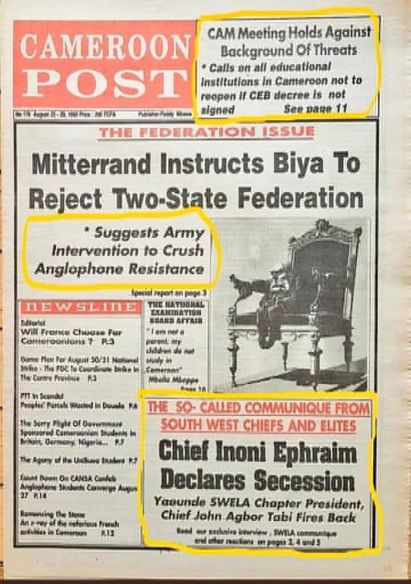
The AAC II declaration was a precursor of things to come. President Biya completely ignored it. Lest we forget – The Buea Declaration of the All-Anglophone Conference-I (1993) – The Force of Argument, Not the Argument of Force, including AACII Resolutions
THE BUEA DECLARATION AND AACII
Issued by the ALL-ANGLOPHONE CONFERENCE
Held At Buea On 2nd and 3rd April, 1993.
IN THE NAME OF THE ALMIGHTY GOD FROM WHOM ALL LIFE, WISDOM, POWER, GLORY AND PROTECTION PROCEED:
WE, THE PEOPLE OF ANGLOPHONE CAMEROON, represented by over five thousand Delegates drawn from the thirteen Divisions of our Territory (Boyo, Bui, Donga-Mantung, Fako, Kupe–Manenguba, Lebialem, Manyu, Meme, Menchum, Mezam, Momo, Ndian, Ngoketunjia) and from all over the rest of Cameroon, among whom, Elder Statesmen and Senior Citizens, Traditional Rulers, Religious and Spiritual Leaders, Leaders of Political Parties, Members of Parliament and of the Economic and Social Council, Farmers, Workers, Students and Elites of all Professions, meeting at Mount Mary Maternity Centre in the historic town of Buea from the 2nd day to the 3rd day of April 1993 in an All Anglophone Conference for the purpose of adopting a common Anglophone stand for the announced national debate on constitutional reform and of examining several other matters related to the welfare of Ourselves, our Posterity, our Territory and the entire Cameroon Nation,
DO SOLEMNLY MAKE THE DECLARATION herein contained for which we offer the following justification:
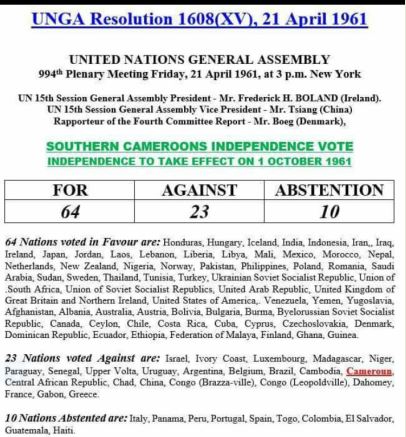
TODAY, NO GROUP OF PEOPLE who freely chose to join a political Union would want to be treated as a captive people. In 1961, the people of Southern Cameroons, through a United Nations-supervised plebiscite, decided to enter into a political union with the people of La République du Cameroun, whom they considered as their brothers and fellow countrymen. They did so, by the grace of God, FREELY and without the involvement or participation of the people of La Republique du Cameroun. They aspired to establish a unique Federation on the continent of Africa, and to evolve a bicultural society in which the distinct heritage of each of the partners to the union would flourish. We believed that such a lofty goal could be achieved. During these past thirty-two years, however, our common experience in the union leaves us in no doubt that far from attaining these ends, we have become a people with a problem.
Our problem, which the intolerant and hypocritical attitude of our Francophone brothers would rather suppress, springs from a breach of trust on the part of Francophone leadership and from a lack of openness in matters of public interest. Within these thirty-two years, our union accord has been violated. We have been disenfranchised, marginalized, and treated with suspicion. Our interests have been disregarded. Our participation in national life has been limited to non-essential functions. Our natural resources have been ruthlessly exploited, with no benefit accruing to our territory or its people. The development of our territory has been negligible and confined to areas that directly or indirectly benefit Francophones. Through manoeuvres and manipulations, we have been reduced from partners of equal status in the union to the status of a subjugated people.
The common values, vision, and goals which we share as a people and those of our Francophone partners in the union are different, and clearly cannot blend within the framework of a unitary state such as was imposed on us in 1972. We are by nature pacifist, patient and tolerant and have demonstrated those qualities since we came into this union. Our Francophone brothers believe in brutalising, torturing, maiming and assassinating dissenters. They have raped our women and daughters and used hand and rifle grenades against peaceful demonstrators. We find such barbarism alien to us and short of the civilised standards of all democratic societies.
We subscribe fully to the Voltairean dictum that: “I wholly disapprove of what you say, but will defend to death your right to say it”. Our idea of freedom of expression and of the press leads us to believe in the open discussion of public issues that affect our lives. Our Francophone brothers suppress freedom of expression and practice censorship of the press. The democratic principle of majority rule and minority rights leads us to believe in the rights and freedoms of the minority. Successive Francophone-led regimes in this country have pursued a policy of assimilation aimed at wiping out our identity. Thus, our vision of a bicultural society has become an elusive, unattainable goal, and will remain so unless and until we devise a better framework within which this aspiration can find expression.
IN BUEA TODAY, we make an important decision. For the benefit of those who hereafter may doubt the rectitude of our intentions, we place on record the following facts:
THE PRE-PLEBISCITE ACCORD
The United Nations document entitled, THE TWO ALTERNATIVES, which was widely circulated on the eve of the plebiscite to explain to the people the implications of their choice, and the Joint Declaration by Prime Minister J.N Foncha and President Ahmadou Ahidjo contained therein, made it clear to the people of Anglophone Cameroon that, in the event of their opting for the second alternative, they would, at independence, be forming a Federation of two States with equal status.
It was clear that the majority in one state would not be allowed to impose its will or interests on the other state. In 1972, all this was disregarded. Not only did the Francophone majority impose their will, fraudulently, on the Anglophone minority, but they also brought to an end the equality of status between the two founding components of Cameroon.
THE CONSTITUTION OF CAMEROON
The union between the Southern Cameroons and La Republique du Cameroun has proceeded these past thirty-two years without any constitutional basis. Without the process of negotiating the terms of reunification having been completed, without any federal constituent assembly having met, without any draft federal constitution having been established, the National Assembly of la Republique du Cameroun, meeting without any Southern Cameroons participation, adopted proposed amendments to the constitution of La Republique du Cameroun, of 4th May 1960. The latter Constitution, as thus amended, was promulgated by Mr Ahmadou AHIDJO, president of La Republique du Cameroun, on 1 September 1961, one month before the reunification of the two Cameroons was to take effect, as the Constitution of the Federal Republic of Cameroon. Insofar as the Legislature of one component of a future Federation cannot validly act as the Legislature of that Federation, the so-called Federal Constitution of 1 September 1961 was null and void ab initio. No valid constitutional or other legal basis has ever existed for the reunification of the two Cameroons and for the common governance of the two territories.
Without prejudice to the fact that the supposed Federal Constitution of 1 September 1961 was clearly a nullity, it is to be observed that Article 47 of that constitution stated that the latter could only be amended by an Act of Federal Parliament and gave the majority of deputies representing each of the two Federated States power to veto an amendment by voting against any bill for such amendment. The same article made it clear that no bill intended to impair the unity and integrity of the Federation could be introduced.
The supposed Federal Constitution of 1 September 1961 laid down a specific procedure for amendment. In disregard of this special procedure, President Ahidjo chose to organise a referendum, in which Francophones took part, to end the Federation. The so-called “Peaceful Revolution” of 1972 was a ploy by Francophones to use their overwhelming majority to alter the basis of reunification, for which Anglophones and Anglophones ONLY had voted. The 1972 referendum was illegal insofar as it was not in conformity with the procedure which the Constitution itself had laid down for the amendment of its provisions and also insofar as its aim was not only to impair the Federation’s unity and integrity, but to abolish the Federation itself. The unconstitutionality of the referendum of 20 May 1972 attaches to, and affects, all enactments following therefrom, notably the constitution of 2 June 1972 and its subsequent amendments.
There is a need now to establish, for the first time, the constitutional basis and the legal framework of the Union between La Republique du Cameroun and the Southern Cameroons.
EXPLOITATION AND RAPE OF OUR ECONOMY
The unconstitutional and illegal imposition of the Unitary form of government was aimed not only at dismantling the institutions of the Anglophone State (Legislature, Government, House of Chiefs, Judiciary, Police force, etc.), but also at exploiting and raping our economy:
- a) Successive Francophone regimes have since stepped up the exploitation of our natural resources, especially oil and timber.
- b) They have destroyed the effective system of financing small-scale industries and enterprises, which Anglophone Cameroon had established through the creation of such institutions as the West Cameroon Development Agency and the Cameroon Bank. They killed that bank.
- c) They looted the West Cameroon Marketing Board, which Anglophone Cameroon had set up before independence, and misappropriated with impunity its huge financial reserves of over 78 billion francs.
- d) They closed down the West Cameroon Electricity Corporation (POWERCAM) and, with it, our cheap source of hydro-electricity supply at Yoke and compelled us to make use of supplies from their source, which, enjoying a monopoly of supply and being aimed at excessive profit-making, charges very high prices. They completely demolished all our hydro-electric installations instead of maintaining them as stand-by sources and confiscated the assets of the West Cameroon Electricity Corporation.
- e) They contrived to squeeze out Anglophone businesses and to maintain an exclusive grasp and control over finance and business. They fix the terms and conditions of credits and control access to finance institutions, both public and private. As a result, familiar Anglophone businesses were starved of credit, such as Fomenky’s Direct Suppliers, Niba Automobile, Nangah Company, Kilo Brothers and the Che Company.
- f) They closed down our agro-industrial establishments such as the Santa Coffee Estate and, later, the Wum Area Development Authority and the Obang Farm Settlement.
- g) They shut our sea and air ports. The present Bamenda Airport, abandoned with unfinished structures and insufficient equipment, can in no way compensate for the closure of the Victoria deep-sea port, the Tiko International Airport, the Besongabang Airport, the Bali Airport, the Weh Airstrip, the inland port of Mamfe and the beautiful port of Ndian. They closed down our indigenous airline, the Cameroon Air Transport (CAT). The law-abiding victims of all these acts were powerless because there was no legal framework within which they could seek and obtain redress.
- h) They have taken away from us the responsibility to plan our towns and to maintain in them the high standard of sanitation that used to prevail. They have destroyed the system of local government and of community development, which we had instituted in Anglophone Cameroon. Today, our main towns, which used to boom with commercial activity- Mamfe, Kumba, Tiko, Nkambe, Wum, Victoria, etc. – have been reduced to ghost towns. In the meantime, no Francophone towns and cities have suffered a similar fate. They continue to boom.
ROAD INFRASTRUCTURE
The government of Anglophone Cameroon pursued a policy of maintaining all-season roads. To this end, particularly difficult stretches of roads, such as the Supe and the Sabga Hills, were tarred. The streets of all divisional chief towns were tarred. The Francophone-led governments have failed to maintain these roads and streets. Worse than that, they have destroyed what we had. Under the pretext of resurfacing our roads, which were tarred before reunification, they dug up the existing tar, destroyed the roads, and in that state, abandoned them, as in the case of Kumba-Mbonge, and the Kumba-Tombel roads. Today, the streets of Kumba, the economic capital of the South West Province, are pools of mud in the rainy season, while Nkambe and Kumbo in the North West wallow in dust up to one foot thick in the dry season. In thirty-two years of independence and reunification, the government has not added a single kilometer of road to the network that existed in Anglophone Cameroon before reunification, other than the few kilometers from the Mungo Bridge to Tiko, from Victoria to Idenau and from Santa to Bamenda which were done primarily to serve the economic and commercial interests of Francophones and to provide easy access to oil installations manned and exploited by Francophones for the benefit of Francophones. Ndian, the division off whose shores the nation’s oil is produced, is without roads. Twice we have witnessed grandiose and pompous ceremonies to mark the commencement of construction work on the Kumba–Mamfe road. Till today, that road remains unconstructed. President Ahidjo had never before cut a tape over an untarred road. He did so for the first time at Mamfe. More recently, Mr Paul Biya publicly announced that he would personally supervise the construction of the Ring Road in the North West Province. There is as yet no sign that the construction of the Ring Road will at last begin.
The neglect of roads in Anglophone Cameroon has had disastrous economic and social consequences for our people and for the development of our territory. We had an all-season trunk A -road running from Victoria through Kumba, Mamfe, and Bamenda to Wum and Nkambe. In their deliberate policy to subjugate us, our Francophone brothers have abandoned the maintenance of this important road. They have, instead, developed the Douala-Bafoussam Road so as to compel us in travelling from Bamenda to Buea or Victoria to pass through their territory.
ROAD CHECKPOINTS
The hundreds of police, gendarmes and customs checkpoints on our roads today seem normal and acceptable to Francophones. They really make this country strange to Anglophones. Between Bamenda and Victoria, there are about 35 checkpoints. This unnecessary restriction on the free movement of people, goods and services serves no useful purpose as traffic cases rarely go to the courts. What may originally have been an exercise with a noble objective has been reduced to a system of road tolls instituted by the Forces of Law and Order with the tacit approval of the government.
DIVIDE AND RULE
We achieved independence and went into Union with La République du Cameroun as a single entity. The Francophone government divided our territory into the North-West and South-West provinces without any prior consultation with us. Francophones now plan to go one stage further by fusing the North West Province with the Francophone Western Province and the South West Province with the Francophone Littoral Province, ostensibly to create bilingual Provinces. These moves are, in fact, aimed at the cultural assimilation and annihilation of Anglophone Cameroon. Enforced uniformity, it is hoped, would eventually wipe out Anglophone identity and secure long-term control of our natural resources for the benefit of France. This surreptitious plan is diabolical and unacceptable to us, especially as its implementation can only take place through the fanning of North West/South West misunderstandings with the complicity of certain self-seeking Anglophones.
MARGINALISATION OF ANGLOPHONES
Since the inception of the Federation, Anglophone Cameroonians have only played second fiddle to their Francophone compatriots, starting with the first Prime Minister of West Cameroon, who, on assuming the role of vice-president of the Federal Republic, set the general pattern of the Anglophone role since then. Anglophones have been appointed mainly into subordinate positions to assist Francophones, even where the latter have been less qualified or less competent.
For 32 years since reunification, Ministries such as those in charge of Territorial Administration, the Armed Forces, Education, Finance, Commercial and Industrial Development, Foreign Affairs, etc., have never been headed by Anglophones. When the Prime Minister is Francophone, there is no Secretary General at the Presidency and no Vice Prime Minister. The Prime Minister wields real power and authority. But when that office comes to an Anglophone, he is hedged in between a Francophone Secretary General at the Presidency and another at the Prime Minister’s office. At the same time, he is saddled with not one, but two, Deputy Prime Ministers on whom real power devolves.
In the Foreign Service, Anglophones rarely get appointed as Cameroon’s Ambassadors to London, Washington, New York, Lagos or Paris. These key diplomatic posts are reserved exclusively for Francophones.
In Home Affairs, there is a rapidly growing tendency to post only Francophone to Anglophone Cameroon in such top administrative positions as Governor, Senior Divisional Officer, Legion Commander, etc.
HUMAN RIGHTS ABUSES
Unlawful detentions, imprisonment, unwarranted searches and seizures, torture by savage agents of the CENER operating La Balancoire, harassment by uncouth gendarmes: these are some aspects of the intolerable Cameroonian reality. Of the hundreds of cases of Human Rights Abuses under a Francophone-led government, we may mention the following among the atrocities committed during these past weeks. In November 1992, a young business executive, Che Ngwa Ghandi, was tortured and regularly beaten by CENER agents and gendarme officers until he died. On Thursday, 25 March 1993, gendarmes opened automatic machine gun fire on a group of peaceful demonstrators in Bamenda, killing three and wounding twenty. On the 18th and 25th of March 1993, in the course of peaceful political demonstrations, 46 Anglophone Cameroonians were arrested, beaten, tortured, and detained in Victoria. Two of these victims, both of them women, were admitted to the hospital with severe injuries
CIVIL LIBERTIES AND THE DUE PROCESS OF LAW
Before reunification, we were certain of the protection and enjoyment of our individual and civil liberties. One could not be arrested and left to languish in prison without being charged. It was unheard of for people’s private premises to be searched without a warrant. The police did not carry guns everywhere. We knew nothing of the night raids called KALE-KALE. The opponents of reunification had warned against these forms of repression, which even then were already being practised in La Republique du Cameroun. Today, 32 years later, Anglophones regret that they had not heeded those warnings.
In a real democracy, everyone is presumed to be equal before the law, and there is certainty that justice will be done if the law is violated. In Cameroon, under the Francophone leadership, executive interference with the judicial process and with the enforcement of judicial decisions is commonplace. Judges have been reduced to agents of the Minister of Justice, while the courts have become departments and services within the Ministry of Justice. The most glaring and dramatic among the thousands of instances of executive disregard for the judiciary recently occurred when, on Monday, 23 December 1992, the Bamenda High Court ordered in Ruling No HCB (CRM) 92 that 173 persons detained and tortured at the Maximum-Security Detention Centre (BMM) be released. In contempt of the court’s decision, the government arbitrarily decided that the court order would not be obeyed. The 173 men and women were instead moved, on the 27th of December, under the most inhumane and degrading conditions of transportation imaginable, to Yaoundé to stand trial before a Francophone Court. This teleguiding of justice and the interference with it by the government are unknown to us, Anglophones.
DISCRIMINATION IN EDUCATION AND TRAINING
Anglophones are systematically discriminated against in the admission of students into professional schools and other institutions of higher learning, notably the National School of Administration and Magistracy (ENAM), where the Anglophone sections have been abolished, and the Higher Teacher Training College (E.N.S).
Anglophones have virtually been excluded since inception from such institutions as the Ecole Nationale Supérieure Polytechnique, the Institute International des Assurances, the School of Surveys, the Business Administration School in Douala, and so on.
There is little or no continuity between the education Anglophone children are given at the primary and secondary levels and the Francophone-dominated, French-oriented education dispensed in our national institutions of higher learning. Many Anglophone youths are forced to travel abroad at great financial costs to themselves and to their families in search of higher education, which is of good quality and consistent with their basic education. Anglophones returning to Cameroon with foreign academic and professional qualifications are subjected to the evaluation and equation of their diplomas and degrees before they can be considered for employment. They often have to wait for as long as 5 years for the “equivalence” process to be completed. The files of over 700 Anglophone civil servants are at present lying in the Ministry of the Civil Service, some of them for over seven years, awaiting “reclassification” of the persons concerned.
After so many years of neglect, good quality secondary technical education for Anglophones has ceased to exist. What a contrast with the technical and commercial education that, in the days of the Federation, was provided by a renowned institution such as the Government Technical College, Ombe!
FRANCOPHONE EXPLOITATION AND DOMINATION
Instances of Francophone exploitation and domination of Anglophones are many. We cite the following examples:
- a) The University of Buea is officially designated as being “Anglo-Saxon”. It is located in the Anglophone Territory and run by Anglophones for the education, primarily, of Anglophones. All this notwithstanding, Francophone government officials in Buea and Yaounde arrogantly instructed the management of the Buea University to deny the use of the latter’s premises and facilities for the purpose of holding the present All Anglophone Conference. Thus, we were reduced to beggars in our own land, confirming once more that we have become a subjugated people.
- b) After reunification, all cinema theatres in Victoria, Buea, Kumba, Bamenda and other Anglophone towns were compelled to show only French-language films.
- c) When there is a football match in France, the entire Cameroon nation is held to ransom by CRTV as the match is shown, sometimes live, on Cameroon Television. The Cameroon Radio and Television Corporation (CRTV) does not react in the same manner when a football or other sporting encounter takes place in England or involves an English team.
- d) Television films and programmes originally made in English are shown in Cameroon only after they have been translated into French, and only in their French version.
- e) Broadcast time on Radio and Television is very unevenly divided between English and French programmes, even though it does not take longer to inform, educate or entertain in French than it does in English. In the end, Anglophones who share equally in the burden of financing Cameroon Radio and Television get far less than ¼ of the service provided by this public utility.
- f) Whereas all of Cameroon’s oil resources at present originate from the Anglophone part of the country only, all oil-related public corporations- SNH, SONARA, SCDP, HYDRAC, etc. – are predominantly staffed by Francophones.
- g) Notwithstanding that all of Cameroon’s oil exploration, production and transformation take place in Anglophone Cameroon, oil-derived revenues are paid to the state directly in Yaounde.
- h) It was a Francophone who appeared in Victoria to buy the property of the National Produce Marketing Board when the organisation wound up. It was a Francophone who appeared in Buea proposing to buy all of the Buea Clerk’s Quarters. It was a Francophone who appeared in Bamenda wanting to buy all of CAPMAE and its installations. It was a Francophone who appeared in Buea wanting to buy the Government Printing Press. It was a Frenchman who was employed to liquidate PAMOL in Ndian. He failed to proceed with the liquidation. For more than four years now, he has been exploiting PAMOL Plantations for the personal benefit of himself and of his Francophone associates and patrons.
- i) Despite the officially bilingual character of Cameroon and despite its wide international spread and high international standing, English is treated as a secondary language in Cameroon. Official texts and documents are issued mainly, and often exclusively, in French.
- j) The independence which the judiciary enjoyed in Anglophone Cameroon has been eroded under successive Francophone-led governments.
- k) In total disregard of the special place occupied in the governance of Anglophone Cameroon by traditional authority, a Francophone-led government arbitrarily abolished the West Cameroon House of Chiefs.
- l) We have been made to suffer all the evils of the association of Cameroon’s economy and public finances with those of France without any corresponding benefits accruing to us. In 32 years since reunification, there are hardly any French-financed development projects, businesses or investments of social or economic consequence in Anglophone Cameroon.
- m) Ours must be the only known situation in the world where there exists a system of law without a legislature. Whereas successive constitutions of Cameroon have contained provisions purporting to preserve the body of law in force in Anglophone Cameroon before the advent of the Unitary State, since the abolition of the Federated State of West Cameroon and its law-making institutions, there now exists no institutional framework for amending or reforming that body of law. The Francophones, who have dominated the law-making process since 1972, have never cared to take the measures necessary to ensure that this body of law is in tune with modern times and with the present-day aspirations of Anglophone Cameroonians in the domains affected and governed by those laws.
INTERNATIONAL ISOLATION OF ANGLOPHONE CAMEROON
By Cameroon’s special language of diplomacy, the people of Gabon, the Central African Republic, Chad and Congo are our ‘brothers”. Each of these peoples is a neighbour and “a brother” of all of us. But when it comes to Nigeria and Nigerians, our language of diplomacy changes. Francophone Cameroonians blame Nigeria for practically everything in Cameroon. Consequently, our Mamfe/Ekok road (one of the busiest in the entire country) is the most neglected because it leads to Nigeria.
It was Anglophone Cameroon that left Nigeria in order to form a Cameroon Federation. If, therefore, there was reason to feel any animosity towards Nigeria and Nigerians, it logically should come from Anglophone Cameroonians. Francophones forget that just as their “brotherliness” vis-à-vis Gabonese, Chadians, etc, is enhanced by their common Francophone heritage, so do Anglophone Cameroonians feel a “brotherliness” towards Nigerians born of a common Anglophone heritage.
In reality, the observed Francophone attitude towards Nigerians is only one manifestation of a rather generalised phenomenon, namely, the isolation of Anglophone Cameroon in Cameroon’s international relations. It is within this same tendency that we must place the reluctance of the Francophone-led government to fulfil the essential conditions for the admission of Cameroon into the Commonwealth, long after Cameroon became a full member of the Francophonie.
WE RECALL THAT before our Territory attained Independence in 1961, we had been practising parliamentary democracy in a politically pluralistic society which was far more developed than what obtains in Cameroon today, three decades later. We regarded democracy as a way of life and as an ideal towards which to strive. We were neither saints nor angels; far from it. But we believed then, as we do now, that whenever a government becomes fraudulent, intolerant and repressive, it is the democratic right of the people to change that government and vote in another. We were spared such a task in Southern Cameroons by the relative uprightness of our government then and by the effectiveness of our system of public accountability. As will be recalled, our first government in Southern Cameroons, led by Dr E.M.L. Endeley, of blessed memory, organised a general election in which it was defeated by the newly emerging opposition. In keeping with the Anglophone conception and practice of democracy, Dr Endeley conceded defeat, and a peaceful change of government took place.
At this point in the history of our union with La Republique du Cameroun, exactly thirty-two years, one month and twenty-three days since our people voted to form a Federation with the people of La Republique du Cameroun:
WHEREAS the people of the Southern Cameroons, and they alone, voted freely in the 1961 plebiscite to achieve independence by joining La Republique du Cameroun in a union erected on a decentralized Federal structure;
WHEREAS by the provision of Article 47 of the Constitution, the unity of the Federal Republic of Cameroon was secured through the prohibition of any amendments that would impair the unity and the integrity of the Federation;
WHEREAS by the unconstitutional referendum of 20 May 1972 the majority population of La Republique du Cameroun imposed a Unitary State on Anglophone Cameroon, in violation of Article 47 of the Constitution and of the pre-Plebiscite Accord jointly signed by Prime Minister John Ngu Foncha for the Southern Cameroons and President Ahmadou Ahidjo for La Republique du Cameroun and mentioned in the TWO ALTERNATIVES, that neither state shall be allowed to impose its will or its interest on the other;
WHEREAS since May 1972, we have patiently suffered numerous indignities, humiliations and injustices in respect of which we repeatedly cried out for redress;
WHEREAS our several petitions, cries and calls for redress have been repeatedly and callously spurned without serious attention being given to them by successive Francophone-led governments;
WHEREAS our Territory, its natural resources, its environment and our cultural heritage are in imminent danger of destruction;
WHEREAS in our relationship with La Republique du Cameroun, the political leadership thereof has time and again demonstrated its bad faith, breach of trust, unwillingness to fulfil promises and undertakings and its propensity for evil, corruption and manipulation;
BUT MINDFUL of the fact that the people, as distinct from the political leadership, of La Republique du Cameroun, may still be desirous of maintaining some union with the people of Anglophone Cameroon;
AND WHEREAS it is expedient that such a union, if it is to last, develop and prosper, should be built on a solid foundation and sustained in a clear atmosphere of openness, trust, mutual respect and a sense of belonging by all;
NOW, THEREFORE, to secure these ends by laying a solid foundation of the union of the two founding entities of present-day Cameroon,
WE SOLEMNLY MAKE THIS DECLARATION:
1) THAT THE IMPOSITION OF THE UNITARY STATE ON ANGLOPHONE CAMEROON IN 1972 WAS UNCONSTITUTIONAL, ILLEGAL AND A BREACH OF FAITH.
2) THAT THE ONLY REDRESS ADEQUATE TO RIGHT THE WRONGS DONE TO ANGLOPHONE CAMEROON AND ITS PEOPLE SINCE THE IMPOSITION OF THE UNITARY STATE IS A RETURN TO THE ORIGINAL FORM OF GOVERNMENT OF THE REUNIFIED CAMEROON.
3) THAT TO THIS END, ALL CAMEROONIANS OF ANGLOPHONE HERITAGE ARE COMMITTED TO WORKING FOR THE RESTORATION OF A FEDERAL CONSTITUTION AND A FEDERAL FORM OF GOVERNMENT WHICH TAKES COGNIZANCE OF THE BICULTURAL NATURE OF CAMEROON AND UNDER WHICH CITIZENS SHALL BE PROTECTED AGAINST SUCH VIOLATIONS AS HAVE HERE ABOVE BEEN ENUMERATED.
4) THAT THE SURVIVAL OF CAMEROON IN PEACE AND HARMONY DEPENDS UPON THE ATTAINMENT OF THIS OBJECTIVE TOWARDS WHICH ALL PATRIOTIC CAMEROONIANS, FRANCOPHONES AS WELL AS ANGLOPHONES, SHOULD RELENTLESSLY WORK.
WE, THE PEOPLE OF ANGLOPHONE CAMEROON, CONVINCED OF THE JUSTICE OF OUR CAUSE AND RELYING FIRMLY ON THE PROTECTION OF THE ALMIGHTY GOD, DO HEREBY, IN SUPPORT OF THIS DECLARATION AND IN PURSUIT OF THE OBJECTIVES THEREIN SET OUT, MUTUALLY PLEDGE TO EACH OTHER, OUR LIVES, WELL BEING, PROPERTY, CAREERS AND FREEDOM.
GOD BLESS ANGLOPHONE CAMEROON!
GOD BLESS THE FEDERAL REPUBLIC OF CAMEROON!
Done at Buea, this third day of April, in the year of our Lord, One Thousand Nine Hundred and Ninety-three.
___________ ____________
Francis K. WACHE Sam EKONTANG ELAD
(Rapporteur) (Chairman of the Conference)
For Participants at the All-Anglophone Conference
AACII BAMENDA
The All Anglophone Conference held its second session in the North West Provincial capital of Bamenda from 29th April to 2nd May 1994 to consider the implications for Anglophone Cameroon of the BIYA Government’s arbitrary suspension for nearly one year of the constitutional reform process initiated in November 1992, to evaluate the execution by the Anglophone Standing Committee of the mandate it received from the All Anglophone Conference meeting in its first session at Buea in April 1993, and to examine other issues concerning the People and the Territory of Anglophone Cameroon.
About the implications for Anglophone Cameroon of the lack of progress in the constitutional reform process, which the BIYA Government has abandoned since June 1993,
The All Anglophone Conference Recalled:
- that it held its first session at Buea in April 1993 for the purpose, inter alia, “of preparing Anglophone participation in the National Debate on Constitutional Reform” which the BIYA Government had undertaken to organise in May 1993;
- that, accordingly, it formally declared the preparedness of Anglophones to participate in Constitutional Talks;
- that, to this end, it:
(i) created a committee for the final drafting of the All-Anglophone constitutional proposals in accordance with the general guidelines which it adopted at Buea;
(ii) directed that the Anglophone Delegation at the constitutional talks should conduct negotiations in close observance of the terms of the Anglophone Draft Constitution tabled at the talks and should, in any case, be bound by that Draft’s proposal regarding the return of Cameroon to the federal form of government.
The All-Anglophone Conference further recalled that, since its first session at Buea in April 1993:
- Its Standing Committee officially submitted Anglophone constitutional proposals in the form of a draft Federal Constitution to the Government in May 1993 and released the said Draft for general public discussion in July 1993.
- The Standing Committee published an official French translation of the Draft Federal Constitution in July 1993 to make the Anglophone proposals accessible and more easily comprehensible to Francophone government officials and to the Francophone generally.
- Its officials have striven to educate, in French, Francophone government officials and the Francophone public in general on the content, spirit and purpose of the Anglophone Constitutional Proposals, notably through the appearance of its Spokesman on the television programme “Actualité Hebdo” in May 1993 and as a guest of the “Club de la Presse” in December 1993;
- It has addressed several memoranda and resolutions to the government on the subject of constitutional reform and, in December 1993, addressed a formal request for an audience to the President of the Republic in the hope that a meeting between the Head of State and officials of the AAC would provide the latter the opportunity to obtain from the former the Government’s official reaction to the Anglophone constitutional proposals;
- It has, knowing the influence that the French Government appears to have on the BIYA Government to engage in dialogue with the All-Anglophone Conference concerning reform.
The All-Anglophone Conference noted with deep regret:
- That, one year since the Anglophone constitutional proposals were officially submitted, the All-Anglophone Conference in 1993 is hereby dissolved and replaced by an Anglophone Council.
- The Anglophone Council shall take over and perform all talks, responsibilities and duties and exercise all powers previously assigned to the defunct Standing Committee by the First All Anglophone Conference.
- Without prejudice to the provisions of paragraph (2) of this Proclamation, the Anglophone Council shall seek and secure Constitutional Talks between Anglophone Cameroon and Francophone Cameroun based on the Draft Federal Constitution which was submitted by the Anglophone Standing Committee in May 1993, as subsequently amended by the Standing Committee.
- In its negotiations with Francophone Cameroun, the Anglophone delegation at the Constitutional Talks shall not accept any arrangement which does not envisage the restoration of an Anglophone Federated state within a Federal Republic of Cameroon in the recognition of the bicultural nature of Cameroon and under which citizens shall be protected as envisaged in the draft Federal Constitution against such violations and abuse as were catalogued in the Buea Declaration.
- The All-Anglophone Conference hereby reiterates the resolution taken at its first session in April 1993 that:
(a) There shall be a single and indivisible Anglophone Delegation at any future Constitutional Talks;
(b) That the members of the Anglophone Delegation to the Constitutional Talks shall be those who, at the opportune moment, and in the spirit of the conference, shall have been mandated as such by the Standing Committee (now Anglophone Council) appointed at the conference;
(c ) That Anglophone Cameroon shall not be bound by any undertakings given or commitments made at the Constitutional Talks by any Anglophone not mandated to attend the talks as a member of the Anglophone Delegation.
- Should the Government either persist in its refusal to engage in meaningful Constitutional Talks or fail to engage in such talks within a reasonable time, the Anglophone Council shall so inform the Anglophone People by all suitable means. It shall, thereupon, proclaim the revival of the Independence and Sovereignty of the Anglophone territory of the Southern Cameroons and take all measures necessary to secure, defend and preserve the Independence, Sovereignty and Integrity of the said Territory.
- Following the Proclamation of the Revival of the Independence and Sovereignty of Southern Cameroons as provided for above, the Anglophone Council shall, without having to convene another session of the All-Anglophone Conference, transform itself into the Southern Cameroons Constituent Assembly for drafting, debating and adopting a Constitution for the Independent and Sovereign State of Southern Cameroons.
- For paragraph (7) above, the Anglophone Council shall enlarge itself to such other organs or individuals as shall appear expedient, beneficial or necessary and in the interest of Southern Cameroons.
- In the event of the situation contemplated at paragraph (7) above, the Independent and Sovereign Southern Cameroons and the Independent and Sovereign Republique du Cameroun shall negotiate their peaceful separation based on the Buea Peace Initiative and on such other terms as shall be mutually beneficial.
We make this proclamation in the name of the Almighty God, for whose protection of Anglophone Cameroon we pray.
For the pursuit of the goals set out in this proclamation, we once again pledge to each other our lives, well-being, property, careers and freedom.
God Bless Anglophone Cameroon!
God Bless Cameroon
Done at Bamenda, this First Day of May in the year of Our Lord, One Thousand, Nine hundred and ninety-four.
For and on behalf of the Second All Anglophone Conference,
Sam Ekontang Elad
Chairman of the Conference
All Anglophone Conference
ALL ANGLOPHONES CONFERENCES III? Why a New Anglophone Conference Will Face Resistance From All Sides
For over 30 years, Anglophones have tried to speak.
In 1993, in Buea, AAC I called for federalism.
In 1994, in Bamenda, AAC II warned of consequences.
Today, we are living those consequences.
But let’s go deeper because the biggest obstacle to a new All Anglophones Conference is not just history.
It is resistance from both the government and within the Anglophone struggle itself.
Why the Government May Resist
Let’s not pretend this is neutral.
• A genuine conference could challenge centralized power and reopen the federalism debate.
• It risks creating a unified Anglophone position, which is harder to ignore or divide.
• It may expose past policy failures and broken promises, forcing accountability.
• And most importantly, it sets a precedent: that sustained pressure leads to structural concessions.
From a power perspective, that’s not attractive.
Why Some Separatist Movements May Resist
This is the part many avoid, but it matters.
• A united civilian platform could reduce their control over the narrative.
• Dialogue, especially around federalism, can be seen as undermining the independence agenda.
• Fragmented groups benefit from operating without a single authority or compromise framework.
• And let’s be honest, some actors gain influence, visibility, or resources from the continuation of the crisis.
So unity becomes a threat. And Then There’s Us
Even within the Anglophone community, mistrust runs deep.
• Federalists vs separatists
• Diaspora vs those on the ground
• Activists vs political elites
Voices like Christian Wiyghan Tumi tried to bridge this gap, but the divisions remain.
So What Does This Mean?
A new All Anglophones Conference is still necessary.
But let’s stop being naive: It won’t just be about organizing people. It will be about overcoming resistance, competing interests, and deep mistrust.
That requires: Clear goals, Legitimate leadership, Real accountability
And the courage to confront uncomfortable truths on all sides. Because without that, we are not building a solution.
Sebastian Amabo Enderly
We are repeating a cycle.
The real question is no longer “Do we need a conference?” It is: who is willing to lose power, comfort, or control to make it work?
#Cameroon #AnglophoneCrisis #Dialogue #Unity #Leadership #Governance #Buea #Bamenda #Yaoundé #Douala