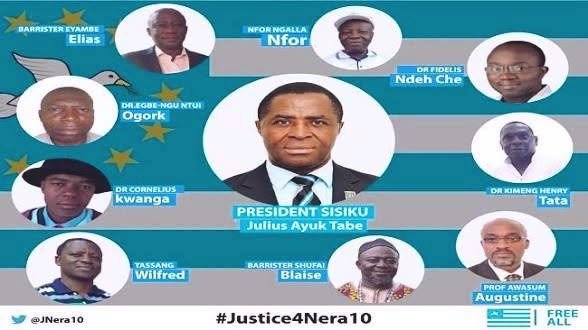
WAR OF INDEPENDENCE: WHY THE NERA 10 AND OTHERS ARE STILL IN JAIL
If Ambazonians genuinely wanted Sisiku Ayuk Tabe and the other members of the NERA 10, along with all those still imprisoned in Yaoundé, to regain their freedom, and were collectively determined to make their release a priority, I believe they could have done so.
Consider this: even in some of the most heavily secured maximum-security prisons in the United States, prisoners have escaped with the assistance of a handful of people. Such escapes rarely happen through individual effort alone. They involve networks of people, planning, coordination, trust, and a willingness to assume considerable risks. What does this tell us about the power of collective determination and organization?
Now consider the condition of Cameroon’s prison system, with its widely reported problems of corruption, institutional weaknesses, and poor administration. The point is not that freeing political prisoners is a simple undertaking. It is that the movement’s capacity to organize, coordinate, mobilize resources, and enable abduction or escape should be a subject of serious reflection.
If even 500,000 Ambazonians directed their collective intelligence, organizational capacity, financial resources, and political energy towards securing the escape of the NERA 10 and others, I will not think it’s an impossible task.
On the other hand, if the entire population of Southern Cameroons were to mobilize against the Biya regime, I do not see how the regime will stand it. The regime may have the machinery of the state at its disposal, but it cannot easily dismiss a population that knows how to organize, speak with purpose, build alliances, and sustain pressure through lawful and coordinated action.
This brings me to a much more uncomfortable observation: some of the greatest obstacles to the Ambazonian struggle have come from within our own ranks. Oftentimes I have stated that the greatest criminals in the Ambazonian struggle are Ambazonians themselves. We have spent considerable energy fighting one another, competing for leadership positions, questioning one another’s motives, and creating divisions where cooperation should have been possible. We have sometimes treated political disagreement as betrayal and personal ambition as revolutionary commitment. And it says a lot about the primitive ethnic backgrounds that we come from.
Meanwhile, people remain in prison. Families continue to suffer. Years pass. And the political and humanitarian costs of our internal divisions accumulate.
I sometimes wonder whether we have adequately examined our own identities and contribution to this situation. We are quick to identify the failures of the Biya regime, and rightly so, but how often do we examine our own identities, as individuals, and as a collective, and the failures of our own political organization, leadership, judgment, and collective responsibility?
My father was involved in Cameroon’s politics during the 1950s and 1960s. Growing up, I learned a great deal about South Cameroonians through his experiences, observations, and conversations. He told me stories about our political culture, our relationships, our ambitions, our divisions, self-seeking habits, and the difficulties of building collective political purpose.
Strangely, as I grew older and began to listen to political discussions, I began to recognize many of the patterns he had described. I have experienced much of what he spoke about as a child. It has been a sobering experience and one that has illuminated me. I have no illusions when I think of Ambazonians.
History sometimes repeats itself, not because people lack the opportunity to learn, but because they refuse to confront the lessons of their own past.
Perhaps one of the most important questions we must ask ourselves is not simply why the Biya regime continues to hold our people in prison, but also why our own political and organizational shortcomings have made it so difficult to sustain a united, disciplined, and effective campaign for their freedom.
We cannot continue to measure our commitment to liberation by the intensity of our rhetoric, the number of declarations we issue, or the political positions we occupy. We must also examine what we have actually built, what we have sustained, and what we have accomplished for those who have sacrificed their freedom.
A liberation struggle must also be a struggle against the weaknesses within ourselves. Otherwise, we risk spending years fighting an external political system while reproducing many of the divisions, ambitions, and failures that have prevented us from becoming the political community we aspire to be.
AMBA SA Communication
WAR OF INDEPENDENCE: WHY THE NERA 10 AND OTHERS ARE STILL IN JAIL