British Southern Cameroons-(Ambazonia)
What role did the Youths of French-speaking Cameroun play in the February 11, 1961, plebiscite of Southern Cameroons?
11 February Celebration: – From Plebiscite to National Youth Day. Historical Distortion or Strategy?
Introduction: The story of what is today celebrated in Cameroon as the February 11 National Youth Day l will be incomplete without looking at the historical context of what some analysts call the hidden history of British Southern Cameroons.
It should be recalled that the former British Southern Cameroons, as a United Nations Trust Territory, was, for administrative convenience, administered from Lagos, Nigeria, until a few months before Nigeria got independence on October 1st 1960. The political representation was in Enugu, the political Capital of the then Eastern Region of Nigeria. That political arrangement ended in 1954 when the 13 representatives of the Southern Cameroons collectively withdrew from the Enugu Regional House of Representatives and demanded a separate political status for the trust territory. For the record, the 13 included Hon. V.T Lainjo, S.T Muna, J.N Foncha, J.T Ndze, A.J Ngala, J.C Kansen, S .C Ndi, S.A George, M.N Foju, N.N Mbile, R.N Charley, Dr E.M.L. Neeley and P.N Motomby Woleta.
The courageous move by the 13 led to the establishment of the first British Southern Cameroons Legislative Assembly. That Assembly held its inaugural session on October 26, 1954, in a ramshackle building in Buea (picture reproduced below). From then onward, October 26 was celebrated as British Southern Cameroons Empire Day. Empire Day was a day of fanfare, especially for the school-going youths. That tradition continued for a while after independence on October 1st, 1961.
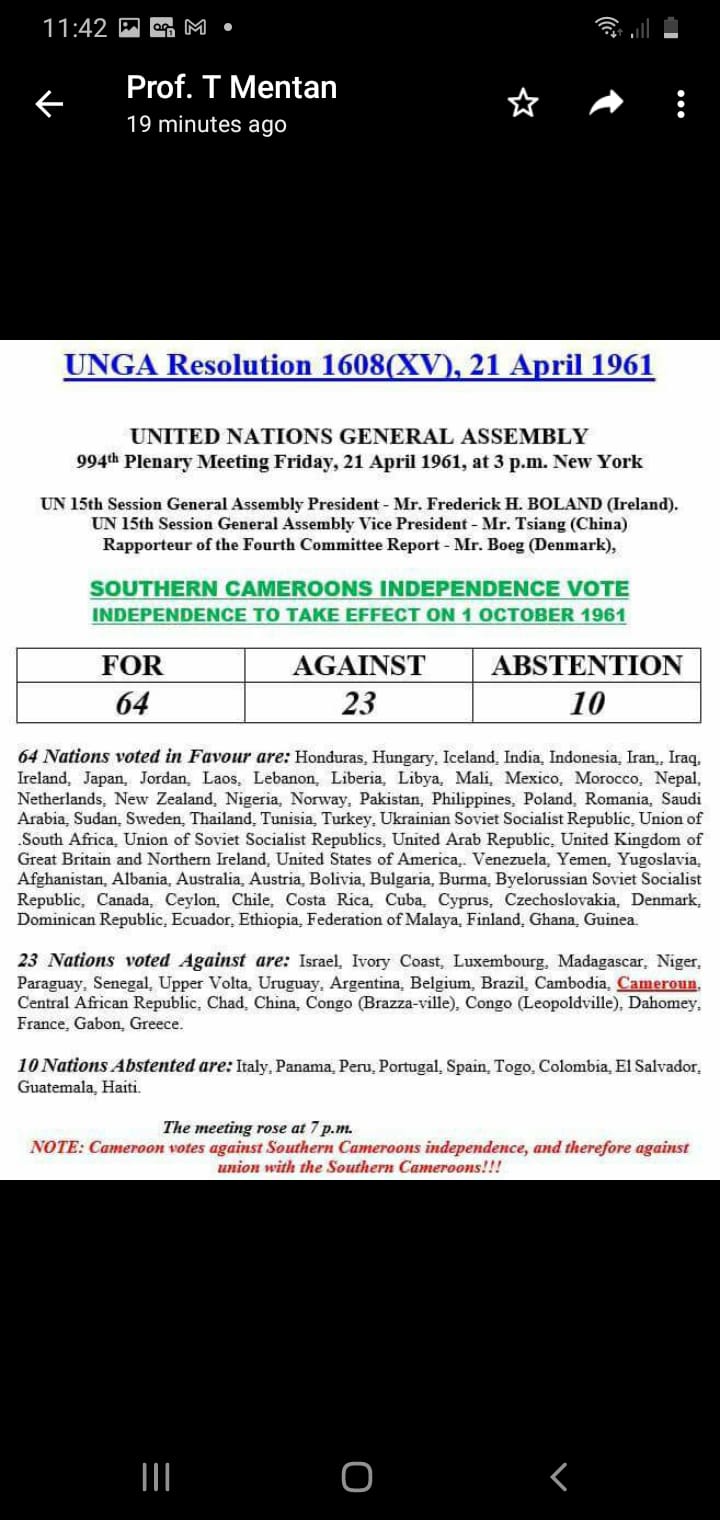
We already know the tortuous journey of British Southern Cameroons to independence, which effectively started in 1959 with the passage of UNGA 1352 (XIV) of 16 October 1959. That is the resolution that officially defined the so called 2 alternatives of independence by joining either Nigeria or French-speaking Cameroun. The choice was going to be made by way of a UN-supervised (not UN-organised) plebiscite to be done not later than March 1961. It should be noted that at the time this resolution was adopted, neither Cameroon nor Nigeria was independent. None of them was a member of the United Nations Organization. The choice of date for the plebiscite was left to the administering authority working in tandem with the government of the Southern Cameroons. The choice of February 11, 1961, as the date of the plebiscite was solely the decision of the Foncha Government in Buea in consultation with the administering authority and other political actors on the ground. 11 February, therefore, had everything to do with British Southern Cameroons today, Ambazonia and nothing to do with French-speaking La Republique du Cameroun.
We are already aware that British Southern Cameroons celebrated October 26, the date its legislature was inaugurated, as Empire Day. The establishment and inauguration of its legislature marked the establishment and recognition of BSC’s international identity. That identity gave the government responsibility not only to agree on the fixed date for the plebiscite but also the authority to effectively organize the plebiscite of 11 February 1961 under a UN supervisor. It is based on this that Dr Djalal Abdoh of Iran was elected as UN Commissioner on March 13, 1959, to oversee the plebiscite. After the independence of October 1, 1961, the Foncha government in Buea thought that it was time to turn the page on colonial institutions. They agreed to rename the Plebiscite Day. It was renamed West Cameroon National Youth Day. The first West Cameroon National Youth Day was celebrated on February 11, 1964. President Ahidjo was invited. Though he did not personally attend, a powerful delegation comprising the Prime Minister of East Cameroun, Mr Charles Asale and the Speaker of the Federal House of Assembly, Hon. Marigoh Mbua, attended.
Between 1961 and 1966, Youth Day celebrations were exclusive to West Cameroon but attracted attention from the Yaoundé political establishment. In 1966, 11 February was formally adopted as National Youth Day. The first National Youth Day was celebrated throughout Cameroon on 11 February 1967. The unanswered questions remain (a) What role did the Youths of French-speaking Cameroun play in the February 11, 1961, plebiscite of Southern Cameroons? (b) Should Southern Cameroons continue to celebrate this day, given what “independence by joining has become?”