EXECUTIVE SUMMARY
Pope Leo XIV’s address in Yaoundé to Cameroon’s authorities, civil society, and diplomatic corps was not merely a diplomatic courtesy; it was a substantive intervention on governance, peace, legitimacy, and national renewal. At a time when Cameroon faces protracted conflict in the Anglophone regions, insecurity in the Far North, youth unemployment, democratic fatigue, corruption, and declining public trust in institutions, the Pope offered a coherent moral and political framework for rebuilding the state-society relationship.
The speech advances a clear philosophy of governance: authority is service, not domination; peace must be built through justice, not imposed through fear; institutions derive legitimacy from credibility and integrity; civil society, women, youth, and religious communities are indispensable actors in national cohesion; and the common good must prevail over partisan or elite interests. The Pope’s intervention is especially relevant in Cameroon’s current context, where the gap between official narratives of stability and the lived experience of many citizens continues to widen.
This article argues that the speech should be read as a take-home message from the papal visit: a call for a new civic compact grounded in transparency, participation, inclusion, rule of law, and integral human development. Far from offering partisan commentary, Pope Leo XIV articulated a normative framework that speaks directly to Cameroon’s governance crisis and points toward a more credible and peaceful national future.
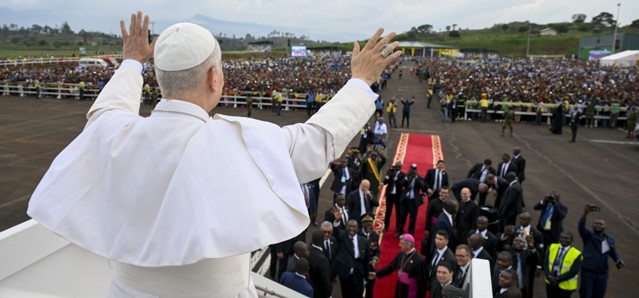
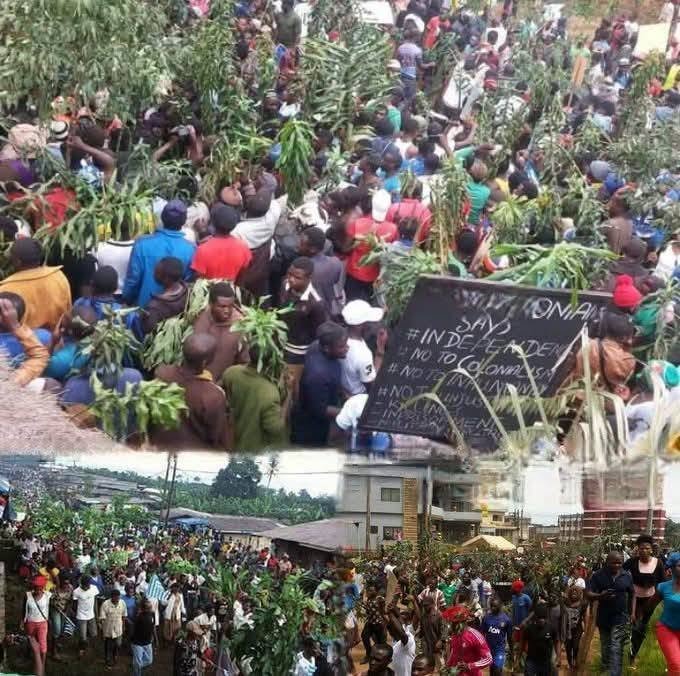
Pope Leo XIV’s speech at the Presidential Palace in Yaoundé on April 15th, 2026, deserves to be read not as protocol, but as diagnosis. Beneath its diplomatic language lies a serious reflection on the crisis of governance in contemporary states, and in Cameroon in particular. In a country marked by armed conflict in the North-West and South-West, terrorist threats in the Far North, persistent corruption, youth disillusionment, weak institutional trust, and a political order often criticized for centralization and inertia, the Pope’s address amounted to a moral audit of public authority.
He did not name parties, endorse factions, or enter electoral controversy. Yet his message was unmistakably political in the highest sense: it concerned how power is justified, how peace is built, and how a nation holds together under strain. The speech offered a framework for good governance that is both ethical and practical, rooted in Catholic social thought but broadly applicable to public life in Cameroon.
1. AUTHORITY AS SERVICE: A DIRECT CHALLENGE TO POLITICAL ENTITLEMENT
The philosophical center of the speech is the Augustinian idea that those who govern are at the service of those they appear to command. This is not a pious aside. It is a direct challenge to patrimonial and self-preserving conceptions of power.
It is important to recall that, Leo XIV is closely linked to the Augustinian tradition because he is a member of the Order of Saint Augustine (O.S.A.), the Catholic religious order that follows the Rule of St. Augustine and emphasizes interiority, community, charity, and the search for God in truth.
At the core of Augustinian philosophy is the claim that truth and the human good are found in God: the restless heart seeks fulfilment only in Him, and knowledge is possible through divine illumination guiding the mind inward toward eternal truth. 1
In Cameroon’s political context, where public office is often perceived less as stewardship than as access to privilege, protection, and patronage, this principle is radical. It redefines legitimacy. A government is not justified simply because it exists, controls institutions, or maintains order. It is justified to the extent that it serves the people, especially the vulnerable.
2. THE COMMON GOOD AGAINST FRAGMENTATION AND EXCLUSION
The Pope’s repeated invocation of the common good is highly significant in Cameroon’s present climate. He insists that governing means seeking the good of the whole people, majority and minorities alike, in reciprocal harmony. This is a pointed statement in a country where linguistic, regional, and identity-based grievances remain politically sensitive.
Cameroon’s diversity has long been celebrated rhetorically, yet many citizens—especially in marginalized regions—have questioned whether the national compact functions equitably in practice. The Anglophone crisis, in particular, exposed the dangers of a state that appears insufficiently attentive to historical grievances, local identities, and demands for meaningful inclusion.
3. PEACE IS NOT A SLOGAN: THE LIMITS OF SECURITY-ONLY GOVERNANCE
The most politically consequential part of the speech is the Pope’s treatment of peace. He speaks plainly about the suffering in the North-West, South-West, and Far North: deaths, displacement, school disruption, and youth despair. He then makes a critical point: peace cannot be decreed, and it cannot be reduced to a slogan.
This line speaks directly to one of the central tensions in Cameroon’s current political life: the gap between official discourse about stability and the lived reality of insecurity, fear, and unresolved grievance in several parts of the country. The Pope does not deny the need for security. But he clearly rejects the illusion that force, messaging, or administrative control alone can produce peace.
His concept of a “disarmed and disarming” peace is important. It suggests that durable peace requires trust, justice, empathy, and credible institutions. In policy terms, this means that military and security responses, while sometimes necessary, cannot substitute for political dialogue, local mediation, educational recovery, victim support, and institutional reform. Cameroon’s challenge is not merely to suppress violence, but to rebuild legitimacy where it has frayed.
4. LISTENING, PARTICIPATION, AND THE DEMOCRATIC DEFICIT
The Pope’s insistence that governing means truly listening to citizens is especially striking in a context where many Cameroonians feel unheard. This is not simply a call for better communication. It is a call for participatory governance.
Cameroon’s political system has often been criticized for excessive centralization, weak local responsiveness, and limited channels for meaningful citizen input. In such a context, listening becomes a democratic virtue and a governance tool. The Pope’s point is that citizens possess intelligence, agency, and practical knowledge that must inform public solutions.
This has concrete implications. It strengthens the case for deeper decentralization, more credible local governance, broader consultation in conflict resolution, and greater inclusion of youth, women, and marginalized communities in public decision-making. A state that does not listen eventually governs in abstraction.
5. CIVIL SOCIETY AS A GOVERNANCE PARTNER, NOT A PERIPHERAL ACTOR
One of the strongest policy signals in the speech is the Pope’s affirmation of civil society as a vital force for national cohesion. He names associations, women’s groups, youth organizations, unions, NGOs, and traditional and religious leaders as indispensable actors in peacebuilding.
This matters in Cameroon, where civil society has often filled gaps left by the state, especially in conflict zones and underserved communities. Humanitarian actors, churches, local associations, and community leaders have accompanied displaced persons, mediated tensions, and sustained social trust where formal institutions have struggled.
The Pope’s message is clear: a resilient state does not fear civil society; it works with it. In Cameroon’s current context, this is a subtle but firm argument against governance models that over-centralize initiative or treat independent civic actors with suspicion. National cohesion requires institutional openness to societal partnership.
6. WOMEN AND YOUTH: FROM SYMBOLIC INCLUSION TO STRATEGIC CENTRALITY
The Pope’s treatment of women and youth is not ornamental. It is structural. He argues that women are often the first victims of violence and prejudice yet remain among the most effective builders of peace. Their voices, he says, must be fully recognized in decision-making. He also identifies youth exclusion, unemployment, and despair as drivers of instability.
This is highly relevant in Cameroon, where women sustain households, local economies, education, and community mediation, yet remain underrepresented in many formal decision-making spaces. Likewise, the country’s large youth population faces unemployment, underemployment, migration pressure, and vulnerability to criminality, drugs, and political manipulation.
The Pope’s point is strategic: inclusion is not charity; it is statecraft. A country that sidelines women weakens its peace architecture. A country that neglects its youth mortgages its future. In governance terms, investment in education, skills, entrepreneurship, and civic inclusion is not secondary social policy; it is core national stability policy.
7. TRANSPARENCY, RULE OF LAW, AND THE CRISIS OF CREDIBILITY
Perhaps the clearest governance prescription in the speech is the call for transparency in the management of public resources and respect for the rule of law. The Pope links both directly to the restoration of trust.
This is a crucial intervention in Cameroon, where corruption remains one of the most persistent public concerns and where anti-corruption efforts are often viewed through the lens of selectivity, political calculation, or limited systemic impact. The Pope’s argument is deeper than administrative reform. He is saying that institutions cannot command trust if they do not embody fairness, accountability, and predictability.
His warning that the law must protect citizens from the arbitrariness of the rich and the powerful is especially important. It points to a core principle of constitutional governance: the state is credible when it restrains power, not merely when it exercises it.
8. SECURITY WITH HUMAN RIGHTS: A NECESSARY BALANCE
The Pope acknowledges security as a priority but insists that it must always be exercised in respect for human rights and with special attention to the vulnerable. This is a balanced but firm principle.
In Cameroon’s context of armed conflict and terrorism, security imperatives are real. Yet the Pope reminds the state that coercive capacity alone does not generate legitimacy. Where citizens experience security operations as arbitrary, abusive, or detached from justice, trust erodes further.
His position is therefore both ethical and pragmatic. Security that respects dignity is more likely to produce cooperation, legitimacy, and long-term peace. Security that ignores dignity may deepen grievance and prolong instability.
9. CORRUPTION AS MORAL AND POLITICAL DECAY
The Pope’s language on corruption is unusually strong. He describes it as something that disfigures authority by emptying it of credibility, and he links it to an idolatry of gain. This is more than moral rhetoric. It is a theory of political decay.
Corruption, in this view, is not simply theft or inefficiency. It is the corrosion of public purpose. It turns institutions inward, weakens service delivery, undermines justice, and teaches citizens that power exists for extraction rather than stewardship.
In Cameroon, where corruption is both a governance issue and a public psychology issue, this framing matters. It suggests that anti-corruption cannot be reduced to campaigns, arrests, or slogans. It requires a deeper transformation of political culture, administrative ethics, and elite accountability.
10. THE POPE’S PHILOSOPHY: GOVERNANCE ROOTED IN HUMAN DIGNITY
Taken as a whole, the speech reveals a coherent philosophy of governance. Its core principles are clear: authority exists for service; peace must be built through justice; institutions require moral credibility; participation is essential to legitimacy; and development must be integral, not merely economic.
This philosophy is grounded in Catholic social thought, but it also speaks to broader traditions of ethical politics. It is anti-authoritarian without being anarchic, pro-institutional without being statist, and morally demanding without being partisan. It asks leaders to govern not only efficiently, but justly; not only legally, but credibly.
CONCLUSION: THE REAL TAKE-HOME FROM THE VISIT
The real significance of Pope Leo XIV’s visit lies in the fact that he offered Cameroon not a technical program, but a normative compass. He named, with diplomatic restraint but moral clarity, the ingredients of national renewal: service, inclusion, transparency, dialogue, integrity, and hope.
For Cameroon’s current political moment, this matters greatly. The country does not suffer only from isolated policy failures. It suffers from a broader crisis of trust between institutions and citizens, between the promise of the republic and the experience of many communities. The Pope’s speech should therefore be read as a call for a new civic compact.
If taken seriously, it is a blueprint for governance beyond inertia, beyond slogans, and beyond fear. It is a reminder that peace without justice is fragile, authority without service is hollow, and stability without trust cannot endure. That is the enduring take-home from Pope Leo XIV’s visit to Cameroon.