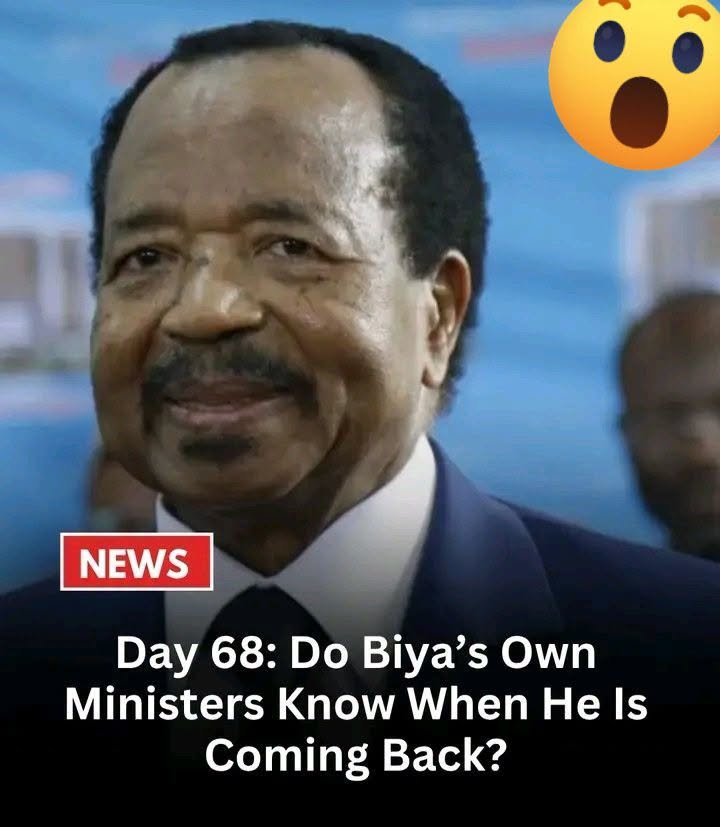
Sixty-eight days after President Paul Biya left Cameroon, the question is no longer only when he will return.
It is increasingly unclear whether the men and women governing in his name know any more than the citizens they continue to reassure.
Biya left Yaoundé on June 7, 2026, for what the Presidency described as a “brief private stay” in Europe. More than two months later, he has not returned, and no official date has been announced for his return.
Twelve days ago, on Day 56 of the absence, government spokesman René Emmanuel Sadi told RFI that Biya was alive, that there was no vacancy of power and that the president would return “very soon.”
Twelve days later, “very soon” has still not produced a date.
That uncertainty is now becoming harder to separate from the functioning of government itself.
Cameroon has not held a Council of Ministers since January 16, 2019, meaning ministers do not routinely sit collectively with the president even under normal circumstances. Presidential instructions are often transmitted through a narrow administrative chain, particularly through Secretary-General at the Presidency Ferdinand Ngoh Ngoh and Civil Cabinet Director Samuel Mvondo Ayolo.
That arrangement has become more visible during Biya’s prolonged absence.
When the Archbishop of Canterbury visited the Presidency on August 4, it was Ngoh Ngoh who received her “in the name of the Head of State.”
On Thursday, Territorial Administration Minister Paul Atanga Nji, visiting victims of the Limbe floods, said Biya had heard about the disaster and sent him with relief assistance.
But that statement raises an obvious question: did Atanga Nji speak directly with Paul Biya?
If not, through whom was the instruction transmitted?
The same question can now reasonably be put to the rest of government.
When did Cameroon’s ministers last have direct contact with the President of the Republic — in person, by telephone or by video call?
That is an answerable question.
And its importance is growing because official explanations of Biya’s absence have provided reassurance without clarity.
Cameroonians have been told that the president is on leave, that he is working normally from abroad, that he is alive, that he is following state files and that he will return very soon.
What they have not been told is when.
There is also an uncomfortable personal dimension for members of government themselves.
Biya announced at the end of 2025 that a government reshuffle would come, but it has still not happened. Ministers therefore continue serving without knowing when the president will return — or when a decree could abruptly end or change their own political careers.
Whether ministers themselves are worried cannot be established.
But the structure of government increasingly leaves them facing the same basic uncertainty as the public: when is the president coming back?
That uncertainty also matters because presidential authority continues to be exercised in Biya’s name.
Decrees continue to appear bearing his signature. Ministers continue to invoke his “high instructions.” Officials continue to insist that the state is functioning normally.
Yet the man from whom all that authority formally flows has not been seen publicly by Cameroonians for 68 days.
The question therefore goes beyond Biya’s health or physical location.
It is now about how much of Cameroon’s government is operating on direct presidential instruction, how much is being transmitted through intermediaries, and how many ministers actually know what is happening at the top of the state.
Africa News Line therefore puts one question directly to members of government:
On what date did you last have direct contact — in person, by telephone or by video — with President Paul Biya?
Any minister willing to answer that question publicly is invited to do so.
At Day 68, Cameroonians are still waiting for a return date.
The more troubling question may now be whether Biya’s own ministers are waiting for the same answer.