
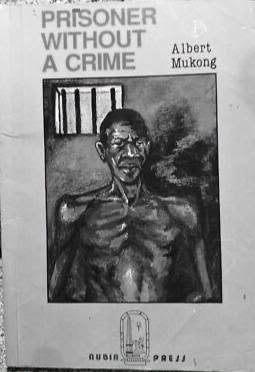
My analysis after reading PRISONER WITHOUT A CRIME by ALBERT MUKONG.
Although written decades before the 2016 outbreak of the armed Anglophone Crisis, the Ambazonia war of independence, Mukong prophetically warned that marginalizing the English-speaking population, suppressing their Anglo-Saxon legal and educational systems, and denying them political autonomy would eventually provoke deep unrest, civil conflict, and a demand for self-determination… If the central government refused to negotiate a fair federal arrangement, Mukong advocated for internationally monitored dialogue and self-determination for the people of the Southern Cameroons
THIS BOOK GOT EMOTIONAL. AS I WAS READING, I FOUND MYSELF LOST IN THE BOOK AS A CHARACTER IN A FILM I WAS PRODUCING. JESUS!!! I COULDN’T STOP CRYING.
Hon. Albert Mukong’s memoir, Prisoner Without a Crime (first published in 1989/1990 by Editions NUBIA), is one of the most significant pieces of political and prison literature from Cameroon. It provides an insider’s critique of the nation’s post-independence governance, human rights abuses, and the roots of the Anglophone problem.
1. Mukong’s Position on Unification
Initial Pan-Kamerunian Stance: Albert Mukong began his political career as the Secretary-General of the One Kamerun (OK) party (which was allied with the UPC / Union des Populations du Cameroun). He initially championed the reunification of French Cameroun and British Southern Cameroons based on anti-colonialism, pan-African solidarity, and genuine democratic equality.
Disillusionment with Execution: Mukong quickly became a fierce critic of how unification was executed in 1961. He argued that the Southern Cameroons was manipulated by political elites and effectively annexed by La République du Cameroun, rather than being treated as an equal, sovereign partner in a genuine union.
2. Opinion on the End of the Federal Structure (1972)
Illegal Annexation: Mukong viewed President Ahmadou Ahidjo’s 1972 referendum—which abolished the 1961 two-state federal system and established the “United Republic of Cameroon”—as an illegal, fraudulent act.
Violation of the Compact: He maintained that the federal structure was the constitutional bedrock guaranteeing West Cameroon’s autonomy, legal system, and political voice. Dismantling it without the genuine, uncoerced consent of Southern Cameroonians constituted an act of bad faith and forced assimilation.
3. Did the Book Address the Union Treaty?
Absence of a Legal Treaty: Yes. Mukong explicitly addressed the legal flaws surrounding the unification process.
Lack of UN Registration: He highlighted that no formal Union Treaty was ever drafted, signed, or deposited with the United Nations between the government of La République du Cameroun and the representatives of Southern Cameroons in accordance with UN Resolution 1608 (XV).
Nullity Argument: Because no legal treaty of union existed, Mukong argued that the administration of Southern Cameroons by Yaoundé lacked legitimate international legal grounding.
4. Mukong’s Fight with President Ahmadou Ahidjo
Refusal to Join the Single Party: When Ahidjo created a one-party state under the Cameroon National Union (CNU/UNC) in 1966, Mukong refused to submit or join the regime, maintaining his fierce independence.
Six Years of Arbitrary Detention (1970–1976): Because of his outspoken criticism of Ahidjo’s totalitarian regime, political centralization, and human rights violations, Mukong was arrested in 1970 and held without trial for six years.
Brutal Conditions: Prisoner Without a Crime documents his incarceration in notorious detention centers and camps, including the BMM (Brigade Mobile Mixte) torture facilities and the Tcholliré political prison camp. He detailed systematic physical abuse, psychological torture, and the suppression of political dissidents under Ahidjo’s police state.
5. Prediction of the Anglophone Crisis and Proposed Solutions
Prediction:
Although written decades before the 2016 outbreak of the armed Anglophone Crisis, the Ambazonia war of independence, Mukong prophetically warned that marginalizing the English-speaking population, suppressing their Anglo-Saxon legal and educational systems, and denying them political autonomy would eventually provoke deep unrest, civil conflict, and a demand for self-determination.
Proposed Solutions:
Return to Genuine Federalism: Re-establishing a true federal structure that guarantees complete equal partnership, state autonomy, and protection of the Anglophone legal, cultural, and educational heritage.
Democratic Governance & Rule of Law: Restoring multi-party democracy, ending state-sponsored arbitrary arrests, and respecting basic human rights.
Self-Determination / Dialogue: If the central government refused to negotiate a fair federal arrangement, Mukong advocated for internationally monitored dialogue and self-determination for the people of Southern Cameroons.
Bye, Prince Agbor Gilbert Ebot/BN