
THE FOUMBAN DECEPTION OF 1961 and THE ULTIMATE INJUSTICE OF MAY 20, 1972 REFERENDUM BY PRESIDENT AHMADOU AHIDJO.
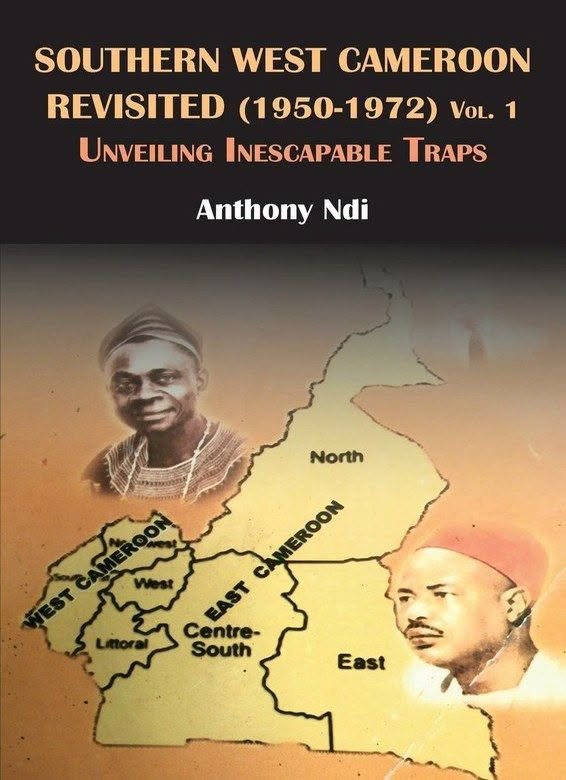
Anthony Ndi’s work provides a critical re-examination of the post-colonial history of Cameroon, shifting the narrative away from the standard “victor’s history” to look at the process from the perspective of the Southern Cameroons (the vanquished). Drawing on declassified British secret papers and historical analysis, Ndi details how the reunification process was flawed from the outset, creating a series of “inescapable traps.”
1. Reasons for Resisting Reunification (1958–1972)
While a strong political movement advocated for reunification, significant resistance existed due to sharp systemic and cultural contrasts:
The Clash of Political Cultures: Southern Cameroons had developed a vibrant, Westminster-style democratic system with multiple active political parties, an independent judiciary, and a free press. In contrast, La République du Cameroun (LRC) was deeply influenced by French centralised governance and quickly evolved into an authoritarian, one-party state.
Economic Autonomy Concerns: Many Southern Cameroonians feared that their robust corporate and agricultural institutions (like the Cameroon Development Corporation) would be subsumed and exploited by a highly centralized government based in Yaoundé.
Fear of Cultural Assimilation: There was strong resistance to losing the Anglo-Saxon institutional heritage—including the educational and legal systems (Common Law)—to a dominant Francophone system.
2. What Went Wrong?
According to Ndi’s analysis, the unification process failed structurally and democratically due to two overriding forces:
The British Colonial “Hoax”: Declassified British secret documents reveal that British colonial policy prioritized shedding administrative burdens rather than ensuring a secure, fair democratic path for Southern Cameroons. The UN-mandated options for the 1961 plebiscite forced Southern Cameroons to choose between joining Nigeria or joining La République du Cameroun, eliminating the option of total independence.
Ahidjo’s Personal Rule: Once the 1961 plebiscite concluded, President Ahmadou Ahidjo progressively personalized and centralized the administration. He brooked no sharing of power with any individual or regional institution, systematically stripping the federal structure of its meaning.
3. Why the People Asked to Revisit the Reunification
The demand to revisit the terms of the union stemmed from a deep sense of betrayal. The 1961 Foumban Constitutional Conference was supposed to outline a federation of two equal states. Instead, Southern Cameroonians watched their autonomy erode.
By 1972, Ahidjo unilaterally abolished the federation through a controversial referendum, establishing a unitary state (The United Republic of Cameroon). This effectively deleted the distinct political existence of West Cameroon, leading Anglophones to argue that the foundational terms of the union had been illegalized and needed urgent renegotiation.
4. Was There a Union Treaty?
Legally and historically, no formal, internationally deposited Union Treaty was ever signed between La République du Cameroun and Southern Cameroons before the unification took effect on October 1, 1961.
While conferences like Foumban took place to negotiate terms, the definitive document that emerged was an amended version of La République du Cameroun’s existing constitution, which Ahidjo’s parliament passed. Because no formal bilateral treaty was ratified or deposited with the United Nations under Article 102 of the UN Charter, legal scholars and Anglophone activists have long argued that the union lacked a valid international legal foundation.
5. Did the Book Predict the Anglophone Crisis?
Yes. Published in 2014, the book acts as an explicit historical warning. By unpacking the “inescapable traps” and labeling the entire historical framework as an unresolved injustice, Anthony Ndi implicitly predicted that the structural flaws, systemic marginalization, and cultural suppression dating back to the 1950–1972 era would inevitably boil over. The current Anglophone crisis is the direct explosion of the historical grievances Ndi uncovers.
6. The Injustices of President Ahmadou Ahidjo
Ndi paints Ahidjo as a matchless dictator who utilized calculated, ambivalent strategies to dominate Southern West Cameroon:
The Foumban Deception (1961): Ahidjo arrived at the Foumban Conference with a pre-prepared constitution that heavily favored a centralized presidency. Taking advantage of the fact that the Southern Cameroons delegation lacked international legal advisers and was under time pressure from the UN deadline, he secured a framework that looked federal on paper but was highly unitary in practice.
Subversion of Democratic Institutions: Ahidjo used emergency decrees and security apparatuses to suppress local dissent. He forced the merger of all political parties into a single national party, the Cameroon National Union (CNU), in 1966, effectively killing the democratic governance that Southern Cameroons cherished.
The 1972 Abrogation of the Federation: The ultimate injustice was the May 20, 1972, referendum. Ahidjo bypassed the constitutional requirement, which dictated that any modification to the federal structure required a majority vote within each specific state assembly. Instead, he forced a national referendum, allowing the overwhelming Francophone majority to outvote and dissolve the autonomy of the Anglophone minority.
Bye.
THE FOUMBAN DECEPTION OF 1961