
Keeping Them Honest
Banal Servitude & Betrayal: The Shocking Castration of Tradition By Manyu Chiefs
The shameful spectacle of conferring a manufactured seditious title of “Chief of Chiefs” to an alien sitting governor amounts to a desecration and auctioning of Manyu ancestral sovereignty
By *Ekinneh Agbaw-Ebai, Boston, USA
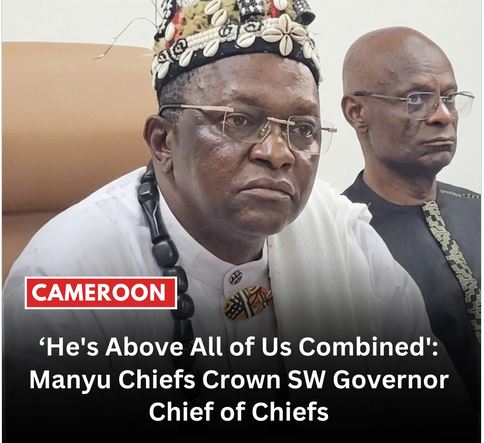
There is a distinct, nauseating pathology to sycophancy, but it takes a special brand of moral bankruptcy for custodians of tradition to turn the desecration of their own ancestral heritage into a grotesque public spectacle, so extravagantly servile, embarrassing, pathetic, disgraceful, and so breathtakingly shameless, that Manyu ancestors like the iconoclastic Chief SA Arrey of Ossing must surely be turning in their graves. In an act of self-inflicted cultural annihilation, a renegade group of sycophantic, pugnacious chiefs, led by Chief Dr. Godson Orock Oben of Mamfe and Chief John Mbi-Araka of Okoyong, gathered in Mamfe to confer the grandiose title of “Chief of Chiefs” (Nfor Ba Nfor) upon Southwest Governor, Bernard Okalia Bilai. Not content with honoring the governor, Chief Oben, who ignominiously extended royal honors to Prophet Jeremiah Omoto Fufeyin, the General Overseer of Christ Mercyland Deliverance Ministry in Warri, Nigeria, made the stunning announcement that all Manyu chiefs were now Governor Bilai’s “subjects” because he is “above all of us put together.” The impropriety of this shocking castration of Manyu traditional heritage is simply mind-boggling and inexcusable. By crowning Governor Bilai “Chief of Chiefs” and declaring him superior to the entire Manyu traditional institution, these “Pharisee” chiefs did not just honor a governor. They humiliated and betrayed their own ancestors for political patronage. One must marvel at the sheer audacity of this ridiculous absurdity.
One almost expected someone to stand up and ask the obvious question: Chief of which chiefs?
Manyu traditional institutions existed long before the Governor’s office. They survived German colonialism, British administration, independence, one-party rule, and multiparty politics. There was a time when traditional institutions of Manyu commanded reverence. Chiefs were custodians of culture, guardians of tradition, and the embodiment of the people’s dignity. They stood between power and the powerless. They were expected to speak truth to power, not audition to become the government’s most enthusiastic praise singers. For centuries, traditional authority derived its legitimacy from the people, from lineage, from history, from culture, and from sacred custodianship of the land. A governor, by contrast, is a temporary administrative appointee of the state. He occupies an office. He does not inherit a civilization. Yet these chiefs, with astonishing enthusiasm, inverted this hierarchy and placed a transient bureaucratic office above institutions that long predate the modern Cameroonian state itself.
The most astonishing part was not the title itself. It was the justification. We are told Governor Bilai deserves this exalted status because the Kumba-Mamfe road was completed during his tenure. Really? Has political illiteracy now become a qualification for traditional leadership? Since when did governors allocate funding for national road projects? Since when did a governor become the financier, contractor, engineer, project manager, and supervising minister of public works? The Kumba-Mamfe road was a state-funded infrastructure project financed through national and international mechanisms far beyond the authority of any governor. To attribute the road to Governor Bilai simply because it was completed under his watch is like crediting a weather forecaster for bringing the rain. The intellectual bankruptcy of this argument is matched only by its shamelessness. By this exact scraping logic, If a bridge is built, he should become “Chief of Concrete.” If a hospital receives new paint, he should be proclaimed “Chief of Doctors.” Perhaps these “langa chiefs” should crown the local SDO “Chief of Electricity” the next time lights come back on after a blackout. One hardly knows whether to laugh or weep at the pitiful spectacle of Tabe Besong, the most prominent Manyu son of his generation, kneeling in front of Governor Bilai.
The absurdity would be amusing if it were not so revealing. For what this episode exposes is not Governor Bilai’s ambition but the astonishing eagerness of some traditional rulers to convert cultural authority into political patronage. What makes the spectacle particularly offensive is the historical amnesia on display. Southwesterners have not forgotten the controversies surrounding Okala Bilai’s posturing on the Anglophone crisis with his uncouth reference to Southwesterners as “dogs”. The tragic irony is that this is the very same Governor who, in 2019, provoked national outrage by treating traditional rulers like administrative foot soldiers, ordering them to march like school children alongside their subjects during 20th May celebrations to prove their patriotism. Yesterday’s insult to traditional dignity has magically become today’s justification for ceremonial adoration. What changed? Did history change? Did tradition change? Did the ancestral constitution of Manyu suddenly acquire a new chapter proclaiming governors superior to custodians of their land? No. Proximity to power simply proved far more lucrative than principle. The justification for the humiliation is as intellectually bankrupt as it is culturally treasonous.
The Noise of the Court Jesters
Let us contrast the sudden, frantic energy of these sycophantic supplicants with their historical paralysis. Where were these chiefs when Manyu was bleeding with the blood of its children; hunted, raped, and killed by the very state this governor represents? When Manyu villages were being systematically razed, reduced to ashes by government forces, these chiefs found comfort in a cowardly, deafening silence. There were no titles manufactured to protest the slaughter of their subjects. When Mamfe General Hospital was burned to the ground, Governor Okalia Bilai did absolutely nothing. Yet, in a display of cognitive dissonance, these misguided, pugnacious opportunists emerged from their hiding holes to crown the very symbol of oppression as the supreme ruler of Manyu’s traditional heritage. They took the sacred, centuries-old dignity of the Manyu people, wrapped it as a ceremonial Ekpe souvenir, and gifted it to a passing holder of public office. This performative condescension is a profound betrayal of the living, the dead, and the ancestors who fought to preserve the dignity and independence of Manyu.
Beyond the comedy lies a more serious concern: what exactly did Manyu gain from this humiliating act of surrender? Has the division’s economic challenges disappeared? Has insecurity ended? Has unemployment disappeared? Has the drug crisis ravaging Manyu villages vanished? Or have we simply witnessed the total devaluation of Manyu cultural dignity and traditional capital? The most painful aspect of all is that Manyu is associated with a fierce spirit of independence. Manyu people are known for resilience, self-respect, and intellectual gravitas. They do not traditionally define themselves through servility. Yet these chiefs have projected a very different image: a people so desperate for recognition that they are willing to elevate a governor into a quasi-monarchical figure and then proclaim themselves his subjects. No satire could be harsher than this reality. The title “Nfor Ba Nfor” carries profound symbolic weight. It may have been intended to elevate the governor. Instead, it exposed a crisis of leadership within sections of the traditional establishment. For in seeking to exalt power, these chiefs succeeded only in diminishing themselves. And in diminishing themselves, they diminished the dignity of the institution they were entrusted to protect.
The tragedy is not that Governor Bilai accepted the title. Politicians rarely refuse praise. The tragedy is that the offer was made in the first place. The people of Manyu deserve chiefs who advocate for them, challenge authority when necessary, and preserve the dignity of inherited institutions. They do not need cultural entrepreneurs manufacturing titles for transient political figures. When chiefs compete in public displays of adulation, they diminish and reduce ancestral institutions to instruments of patronage. When culture becomes a currency for currying favor, culture itself is impoverished. When titles become instruments of flattery, they cease to command respect. For if every governor becomes a “Chief of Chiefs,” then the title means nothing. And when a title means nothing, the institution behind it soon follows. A chief should not be a griot; neither should a palace become an annex of the governor’s office. A chief is supposed to be the conscience of the community, and defend the dignity of his people. A chief is supposed to stand before power, not kneel before it. Instead, Manyu was treated to a masterclass in ceremonial self-abasement. The moment a chief transitions into a royal beggar, he ceases to command reverence; culture then becomes a public-relations accessory.
Chief Oben, Mbi-Araka and their fellow co-travellers should, please, spare us the noise. Spare the proud, independent-minded people of Manyu the agonizing spectacle of your public servility. If you are determined to crawl before the feet of power, do so in the private shadows of your own conscience. Do not drag the collective dignity of an entire people into the gutter with you. By attempting to elevate a governor above the custodians of the land, you have failed to make him a king; and made yourselves royal beggars. It is shameful and pathetic, and history will record your names exactly as you appeared in Mamfe: as the enthusiastic architects of your own cultural self-annihilation.
*The author is a Crown Prince of Awanchi-Betieku Clan and the Grandson of Ta-Ekinneh, Nfor Nchemba
Banal Servitude & Betrayal: The Shocking Castration of Tradition By Manyu Chiefs