
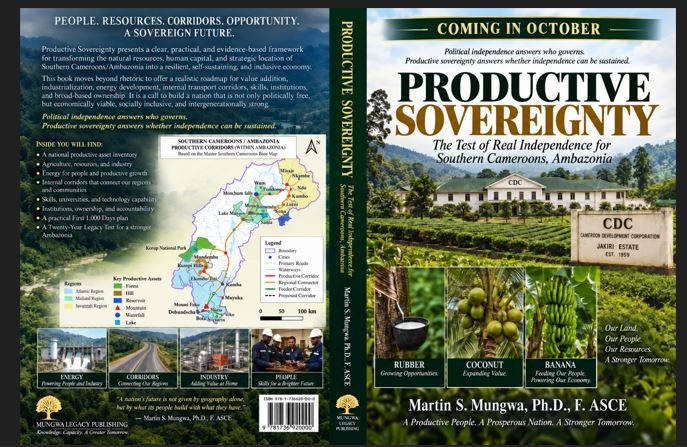
COMING IN OCTOBER
FROM ADVOCACY TO STATECRAFT.
PRODUCTIVE SOVEREIGNTY
The Test of Real Independence for Southern Cameroons, Ambazonia
By Martin S. Mungwa, Ph.D., F. ASCE

With Foreword by Professor Bridget A. Teboh
Approximately 372 pages • 10 chapters • maps • figures • operating frameworks • interludes • implementation tests
Political independence answers who governs. Productive sovereignty answers whether governing authority can be sustained.
The test of real independence is not whether a country can stand alone. It is whether it can stand among others without being structurally controlled by any of them.
Current manuscript pagination is approximate and may change slightly during final typesetting.
A BOOK ABOUT WHAT MUST WORK THE MORNING AFTER
This is not another book about what independence should mean in theory.
It is a book about what must work the morning after.
For generations, the Southern Cameroons question has been argued through history, constitutional legitimacy, identity, self-determination, diplomacy, injustice, conflict, and recognition. Those questions remain important. Productive Sovereignty deliberately pushes the conversation into a harder arena:
If political authority changed hands tomorrow, could the country actually function?
Could the electricity remain on? Could teachers, nurses, technicians, judges, and civil servants be paid? Could farms feed the population and reach markets? Could roads and bridges be maintained? Could banks settle payments? Could contracts be honored? Could local businesses compete? Could technology be operated after foreign suppliers left? Could institutions survive their founders? Could a government finance itself without exchanging one form of dependency for another?
That is the central argument of Productive Sovereignty.
The book does not advocate economic isolation. It advances a doctrine of capability, ownership, options, resilience, disciplined interdependence, and institutions strong enough to survive both founders and foreign partners.
THE CENTRAL THEME
Political freedom becomes durable only when it is backed by productive systems that work, capital that circulates, citizens who become owners, firms that can compete, infrastructure that can be maintained, institutions that survive personalities, and partnerships that do not become permanent dependency.
The book asks the reader to follow the productive source, follow the money, identify the owner, find the single point of failure, test what happens when the partner leaves, and finally ask what remains twenty years later.
TEN CHAPTERS. ONE OPERATING SYSTEM FOR STATECRAFT.
CHAPTER 1 — THE TEST OF REAL INDEPENDENCE
From Political Freedom to Productive Sovereignty
The book begins where many independence arguments end. What would a new political authority actually inherit? Land, plantations, power systems, roads, ports, universities, firms, financial institutions, contracts, liabilities, and maintenance backlogs are subjected to a National Productive Asset Inventory. The chapter introduces the Productive Asset Test and asks whether political authority would be backed by systems capable of producing repeatable value.
CHAPTER 2 — WHO SIGNS? WHO PAYS? WHO OWNS?
Authority, Revenue, Procurement, and the Architecture of Economic Power
A flag does not determine who controls an economy. Contracts often do. This chapter follows authority, capital, ownership, concessions, guarantees, procurement, technology rights, beneficial ownership, and revenue. Its question is simple but consequential: when a government signs, who gains control—and what remains when the contract ends?
CHAPTER 3 — CAPITAL THAT CIRCULATES
From Savings and Investment to Circular Wealth
Investment entering an economy is not enough. Where does the money go next? This chapter traces leakages through imported machinery, engineering, finance, insurance, software, logistics, debt service, and profit repatriation, while rejecting the simplistic idea that every foreign payment is bad. It introduces the Capital-Circulation Loop and the deeper objective of Circular Wealth: converting income into savings, reinvestment, productive assets, and ownership.
CHAPTER 4 — FEED AND POWER THE STATE
Agriculture, Processing, Energy Security, and Rural Productive Wealth
Bananas, cocoa, coffee, palm oil, plantain, fisheries, livestock, and horticulture are treated not merely as commodities but as productive systems. Agriculture must connect farms to processing, storage, power, logistics, finance, standards, and markets. Energy receives the same systems treatment: generation without transmission, distribution, maintenance, protection, spares, and technical capability is not energy security.
CHAPTER 5 — NIGERIA NEXT DOOR
Turning Proximity to a Large Market into Productive Advantage
Nigeria is examined not simply as a neighbor but as a customer, supplier, industrial partner, logistics relationship, source of capital, and technology market. The chapter asks what Southern Cameroons/Ambazonia could actually sell, buy, process, finance, and move repeatedly across the border. Its governing principle is: the market should help determine the corridor—not the other way around.
CHAPTER 6 — BUILD THE PRODUCTIVE CORRIDORS FIRST
Production, Markets, Gateways, and the Corridor-Before-Port Rule
This chapter challenges prestige-first infrastructure. It begins with productive sources, feeder roads, power, storage, processing, customs, markets, and payments before scaling gateways. Victoria is examined as a future maritime and commercial gateway and Tiko as an aviation, logistics, and agro-industrial node. The doctrine is memorable: a port without a productive hinterland is infrastructure waiting for cargo.
CHAPTER 7 — FROM RESOURCES TO PRODUCTIVE INDUSTRY
Minerals, SMEs, Procurement, Supplier Development, and Technology Capability
Natural-resource optimism is subjected to the Resource Integrity Gate: speculative claim → documented occurrence → exploration prospect → resource → reserve → operating production. The chapter then asks how resources become firms, suppliers, engineering capability, value addition, technology, and regional competitiveness. It introduces the First Supplier Test and insists: do not lower the standard—raise the firm.
CHAPTER 8 — KNOWLEDGE AND STRATEGIC PARTNERSHIPS
Universities, Innovation, Brazil, Africa, and Partnership Without Dependency
Universities must participate in production. Knowledge must move from problem to research, prototype, application, commercialization or public deployment, value, and reinvestment. Brazil, Africa, the diaspora, universities, technical colleges, professional engineering, and international partnerships are examined through one strategic doctrine: Friendly with many. Captured by none.
CHAPTER 9 — INSTITUTIONS, OWNERSHIP, AND VIABILITY
From Personalities to a Nation of Owners
A sustainable state cannot be built around indispensable personalities. Property rights, commercial law, procurement integrity, courts, audit, public accounts, regulatory systems, and succession mechanisms must survive leaders. But the chapter goes further: GDP and employment are not enough. Citizens must acquire assets. The objective is a Nation of Owners.
CHAPTER 10 — FROM THE FIRST 1,000 DAYS TO THE TWENTY-YEAR LEGACY
Sequencing, Competitive Capability, Resilience, and the Final Test of Real Independence
The final chapter converts doctrine into sequence. The first 100 days prioritize continuity: treasury, food, electricity, borders, contracts, critical services, and asset protection. The remainder of the first year builds legal, financial, procurement, and institutional architecture. Years two and three deepen production, power, corridors, gateways, supplier networks, and university-industry systems. Then comes the ultimate stress test: partner exit, founder exit, and what remains twenty years later.




COMING IN OCTOBER
FROM ADVOCACY TO STATECRAFT.