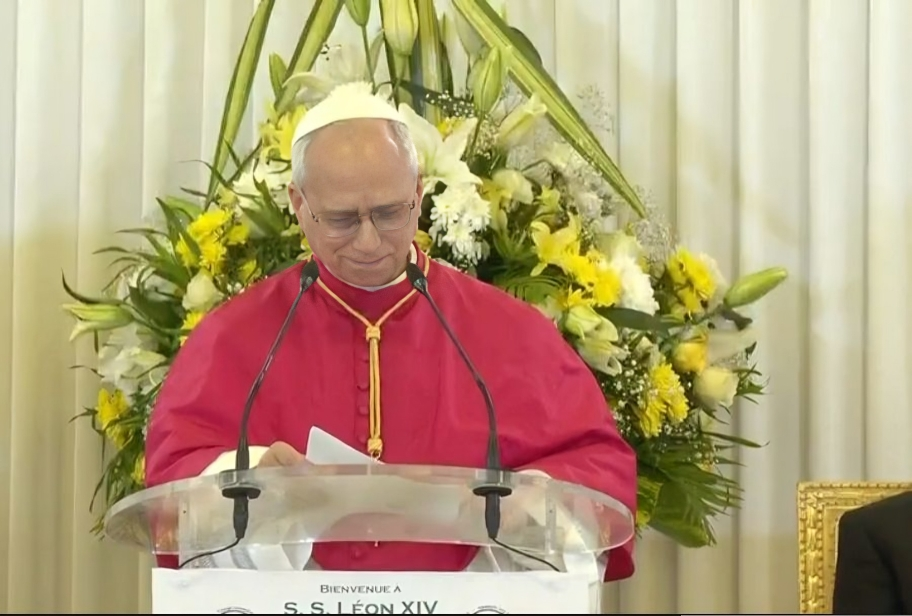
Pope’s Message In Yde on April 15, 2026
Mr. President,
Distinguished Authorities and members of the Diplomatic Corps, Ladies and Gentlemen!
I sincerely thank you for the warm welcome I have received and for the words of welcome that have been sent to me. It is a profound joy to be in Cameroon, often called “Africa in miniature” because of the richness of its territories, cultures, languages, and traditions. This diversity is not a weakness, but a treasure. It is a promise of fraternity and a solid foundation for building lasting peace.
I come among you as a pastor and servant of dialogue, fraternity, and peace. My visit expresses the affection of the Successor of Peter for all Cameroonians, as well as the desire to encourage everyone to pursue, with enthusiasm and perseverance, the building of the common good. We are living in a time when resignation is spreading and a feeling of powerlessness tends to paralyze the renewal that people deeply feel. How much hunger and thirst for justice! How much thirst for participation, for visions, for courageous choices, and for peace! My greatest desire is to touch the heart of each person, especially young people, who are called to shape, including in the political sphere, a more just world. I also wish to express my commitment to strengthening the bonds of cooperation between the Holy See and the Republic of Cameroon, founded on mutual respect, the dignity of every human person, and religious freedom.
Cameroon remembers the visits of my Predecessors: that of Saint John Paul II, messenger of hope for all the peoples of Africa; and that of Benedict XVI, who emphasized the importance of reconciliation, justice, and peace, as well as the moral responsibility of those in power. I know that these moments have marked your national history, like demanding exhortations to a spirit of service, unity, and justice. We can therefore ask ourselves: where do we stand? How has the Word that was proclaimed to us borne fruit? And what remains to be done?
1,600 years ago, Saint Augustine wrote words that remain remarkably relevant today: “Those who command are at the service of those whom they appear to command. They do not command out of a thirst for domination, but out of a duty to provide for needs; not out of pride to impose themselves, but out of compassion to protect.”1 From this perspective, serving one’s country means dedicating oneself, with a clear mind and an upright conscience, to the common good of all the people: the majority and the minorities, in their mutual harmony.
Today, like many other nations, your country is going through difficult times. The tensions and violence that have struck certain regions of the Northwest, Southwest, and Far North have caused profound suffering: lives lost, families displaced, children deprived of schooling, young people who see no future. Behind the statistics are faces, stories, and shattered hopes. Faced with such dramatic situations, I called on humanity at the beginning of this year to reject the logic of violence and war, and to embrace a peace founded on love and justice. A disarmed peace, that is, one not based on fear, threats, or armaments; and disarming, because it is capable of resolving conflicts, opening hearts, and fostering trust, empathy, and hope. Peace cannot be reduced to a slogan: it must be embodied in a personal and institutional approach that rejects all forms of violence. That is why I repeat it forcefully: “The world thirsts for peace. […] Enough of wars, with their painful trail of death, destruction, and exile.” This cry is intended as a call to action for the will to contribute to genuine peace, placing it above all partisan interests.
Peace, in fact, cannot be decreed: it is embraced and lived. It is a gift from God that develops through patient and collective work. It is everyone’s responsibility, first and foremost that of civil authorities. To govern is to love one’s country, but also neighboring countries. The commandment “love your neighbor as yourself” also applies to international relations! To govern is to truly listen to citizens, to value their intelligence and their capacity to contribute to developing lasting solutions to problems. Pope Francis stressed the need to move beyond “this conception of social policies as a policy toward the poor, but never with the poor, never for the poor, and even less as part of a project that unites peoples.”
In this shift in approach, civil society must be considered a vital force for cohesion of peace.
Pope’s Message In Yde on April 15, 2026