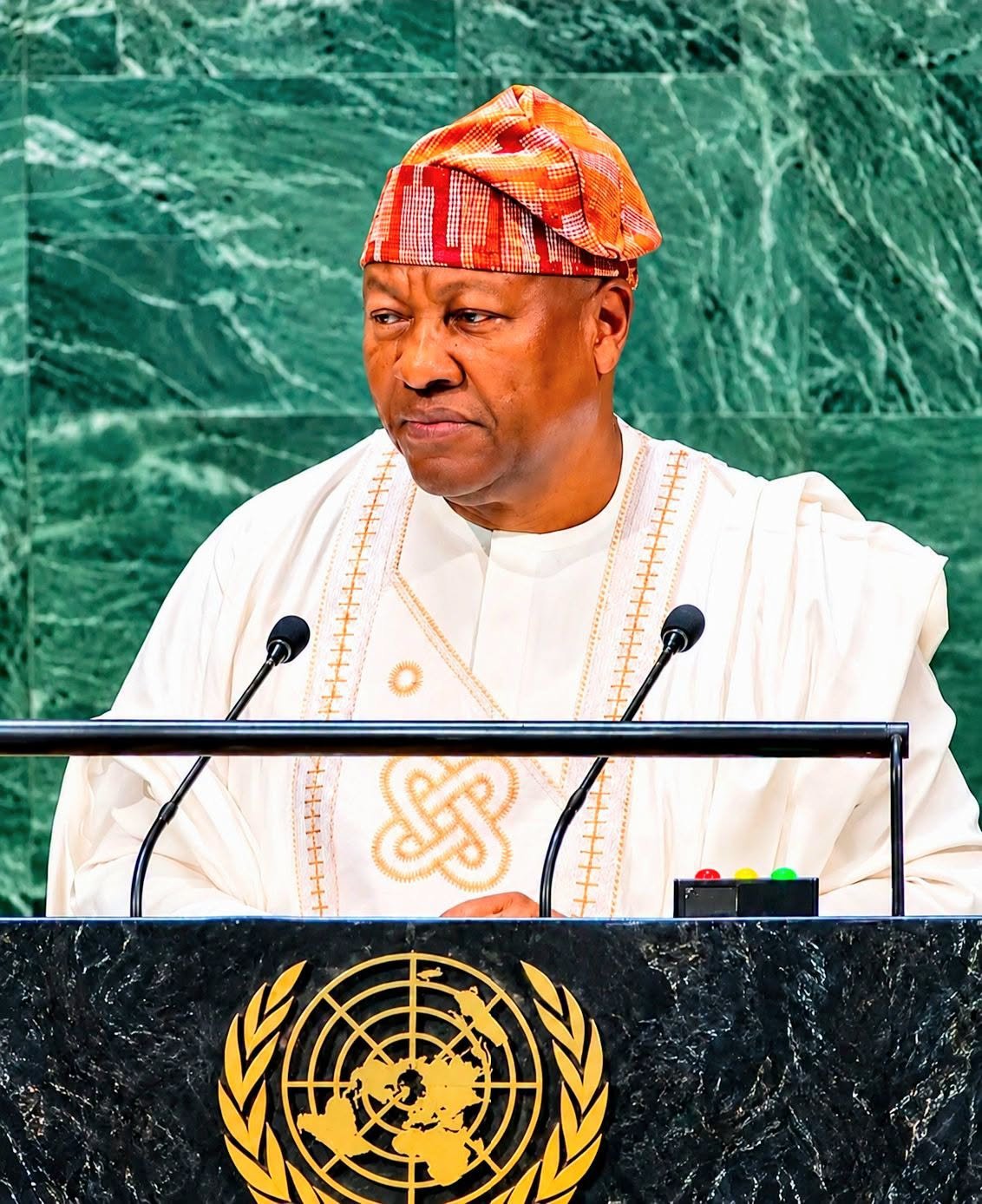
President John Dramani Mahama Spoke Truth at the United Nations
Ghana has now spoken at the United Nations General Assembly. President John Dramani Mahama delivered one of the more forceful African speeches, touching Gaza, Palestine, Cuba, slavery and reparations, Africa’s minerals, debt, climate financing and reform of the international system.
1. Gaza: Mahama condemned the killing of Palestinian civilians and demanded international action.
He said:
“The time has come for us to stop using diplomatic euphemisms to veil the human carnage that is taking place in Gaza.”
He specifically invoked the death of five-year-old Hind Rajab and Palestinian children, adding:
“Collective punishments, enforced starvation and mass displacement are flagrant violations of international law.”
2. Palestine: Ghana reaffirmed recognition of a sovereign Palestinian state.
“Ghana remains unwavering in its recognition of the sovereign state of Palestine.”
He called for a viable two-state solution in which Israel and Palestine live side by side in peace and security.
Mahama also condemned Hamas:
“We condemn all acts of terrorism by Hamas that triggered this conflict.”
His broader argument was:
“Our moral standards cannot be selective.”
3. Cuba: End the U.S. economic, commercial and financial embargo.
Mahama called for:
“The immediate lifting of the decades-long economic, commercial and financial embargo that has been imposed on Cuba.”
He went even further:
“The world must support Cuba’s new economic and social program.”
4. Sudan and the Sahel: The world must respond more strongly.
Mahama described Sudan as:
“The world’s worst humanitarian crisis.”
He also called for solidarity with countries confronting terrorism in the Sahel.
5. Slavery and reparatory justice: acknowledgement must result in repair.
This was one of the biggest themes of his speech.
“True healing requires truth. And truth requires acknowledgement. And acknowledgement must lead to meaningful repair.”
He reminded the Assembly that enslaved Africans provided unpaid labor that helped build:
“The cities, industries, banking institutions, and empires of the modern Western world.”
For Mahama, recognizing slavery as a crime against humanity should therefore have consequences beyond apologies.
6. Reform the global financial system, which he says is weighted against Africa.
Mahama described:
“A global financial architecture that is weighted against Africa and people of African descent.”
He identified unfair trade, resource extraction, credit ratings and debt among the structures requiring reform.
7. Address the Global South’s debt burden.
He specifically identified:
“Unsustainable debt burdens of the Global South.”
He did not explicitly demand blanket debt cancellation in the portions captured, but clearly placed debt within his demand for structural financial reform.
8. Change what he called discriminatory credit ratings against Africa.
Among the structures he demanded be addressed were:
“Discriminatory credit ratings.”
9. Developed countries must deliver their climate money.
This was one of his clearest financial demands:
“Climate justice demands that developed nations must fulfil their long overdue financial commitments.”
10. Give climate assistance as grants, not loans.
Mahama was unusually specific:
“Mitigation support must be operationalized with predictable non-debt-creating grants, not loans that further indebt fragile economies.”
In plain language: climate money should be given as grants rather than additional debt.
11. Finance public-health infrastructure across the Global South.
Mahama called for a global health architecture that:
“Funds resilient public health infrastructure across the Global South.”
He also demanded stronger regional vaccine and therapeutic manufacturing and epidemic surveillance.
12. Stop extracting Africa’s minerals only to process them elsewhere.
Mahama warned:
“Africa will not remain a passive arena for a new scramble for resources.”
His alternative was explicit:
“We will process our minerals at home.”
And:
“We will build local industries that create dignified jobs for our youth and will retain the value of our natural resources in Africa.”
13. Give Africa permanent representation on the UN Security Council.
Mahama described Africa’s continued exclusion as:
“Fundamentally unacceptable in the 21st century.”
He demanded permanent African representation with the corresponding rights and responsibilities.
14. But Mahama insists Africa is not begging.
He declared:
“Africa does not seek charity. Africa seeks equal partnership that is anchored in mutual respect.”
Yet his speech still included clear external financial demands: climate finance, non-debt-creating grants, internationally supported health infrastructure, debt reform, changes to credit ratings, reparatory justice and broader restructuring of the global financial system.
15. He also told African leaders to put their own houses in order.
This was an important counterbalance:
“As African leaders we must also do what is required to put our own houses in order.”
And specifically:
“We must commit to the fight against corruption and ensure that every dollar of our people’s money counts.”