
EDC and French Firm ISL Launch Feasibility Studies for Mbakaou Hydroelectric Plant in Cameroon 2024
The Mbakaou Hydroelectric Power Plant: A Beacon of Sustainable Energy in Cameroon
In the heart of Cameroon, a significant step towards sustainable energy development is underway. The Electricity Development Corporation (EDC) has partnered with the French engineering firm ISL to conduct comprehensive feasibility studies for the Mbakaou hydroelectric power plant. This collaboration marks a pivotal moment in Cameroon’s energy sector, promising to bolster the nation’s power supply amidst an unprecedented energy crisis.
The Mbakaou hydroelectric project, nestled in the septentrion with a projected output of 250 to 300MW, is a testament to the country’s commitment to harnessing renewable resources. The contract, signed by Dr. Théodore Nsangou, Managing Director of EDC, and Thomas Barbat, representative of ISL, encompasses technical, environmental, social, and financial studies, ensuring a holistic approach to the plant’s development.
This initiative aligns with the government’s SND-30 development strategy, aiming to achieve a 5000MW energy supply by 2030. The strategic location of the Mbakaou foothold plant, near Tibati, will facilitate the interconnection between the north and south of Cameroon, potentially exporting up to 100MW of electricity to neighbouring Chad.
The existing Mbakaou dam, which the project will utilize, offers several advantages, including its proximity to a planned transformer station and the presence of an upstream reservoir dam. These features not only expedite the project’s implementation but also minimize environmental impact, making it a more manageable and eco-friendly endeavour.
The Mbakaou hydroelectric power plant is not just an energy project; it’s a beacon of hope for the northern regions of Cameroon. It promises job creation, reduced dependence on the Lagdo dam, and an increase in the region’s energy autonomy. With the feasibility studies set to be completed by the end of 2024, the project’s commencement in early 2025 is eagerly anticipated.
As Cameroon navigates through its energy challenges, the Mbakaou hydroelectric power plant stands as a symbol of progress, innovation, and the unwavering spirit of a nation committed to a brighter, more sustainable future.
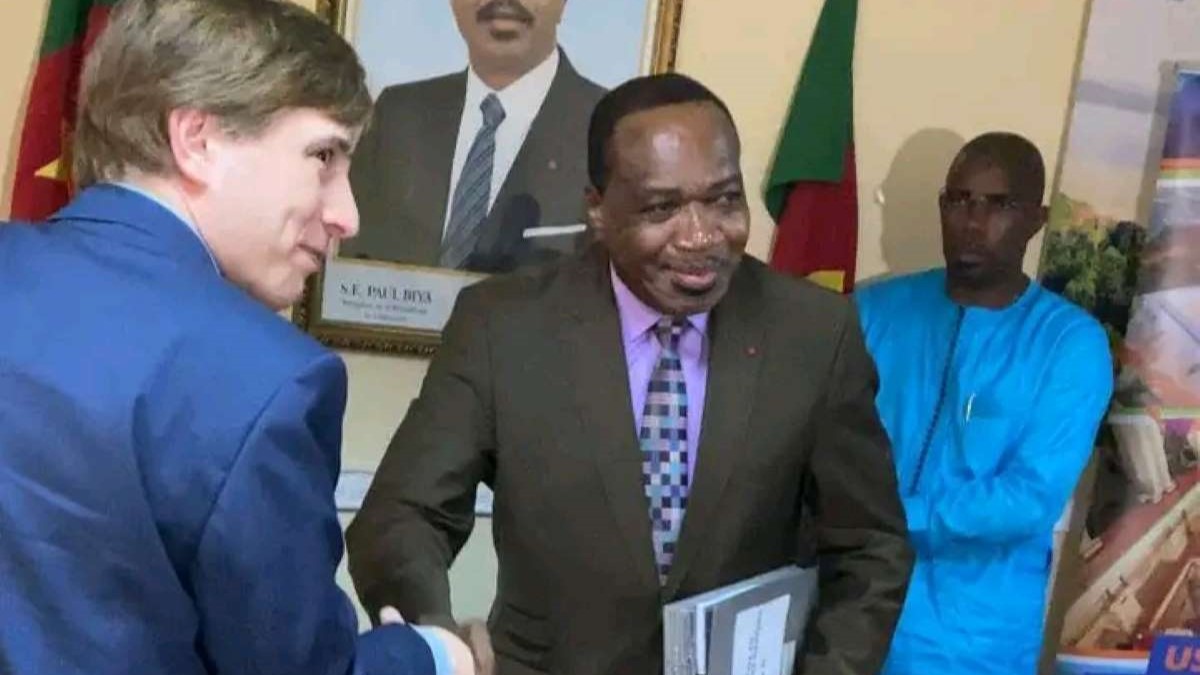
July 17, 2024, marks the beginning of the preliminary phase of the implementation of the Mbakaou hydroelectric power plant project in the Djerem department, Adamaoua region of Cameroon. And for good reason, the signing today of the contract to launch the technical, environmental and social feasibility study of the new hydroelectric power plant of the Mbakaou dam between the Electricity Development Corporation (EDC) and the consortium of French engineers led by ISL, composed of Nodalis and Faton.
This preparatory phase for the start of the work planned for 2025 according to Cameroon’s 2025-2027 Priority Investment Program officially begins on July 18 for 6 months. According to the timetable provided by the French consortium, it is planned that a mission made up of engineers and environmental and social specialists will be deployed on the ground for a week. This is to “analyze the possibilities of positioning the plant structure and other necessary facilities to be able to analyze the environmental and social impacts to build the project and to be able to initially carry out a study that will determine which is the right variant of the project to carry out at the pre-feasibility level. Then move on to a detailed feasibility phase,” explains Thomas Barbat, Managing Partner at Nodalis, a member of the ISL firm.
It must be said that the studies that are starting today are a prerequisite for the realization of projects of such magnitude. “These are technical, economic and financial studies to prepare the development of the project. (…) It is based on the studies that we will conduct that the very type of development of the project will be defined with the different plans that we will discuss with the government and the World Bank,” explains Théodore Nsangou, Director of EDC.
The current study will also determine the real cost of this energy infrastructure. “…We will continue with the government’s representative some avenues of study of financial models for this project which will be innovative. For the moment, we do not yet know if it is a public-private partnership or a classic project like Lom-Pangar. The studies will tell us and it will also be with the help of the government”, affirms Théodore Nsangou. In the meantime, the government in its Priority Investment Program is counting on an envelope of 315 billion CFA francs with a contribution from the State estimated at 8 billion CFA francs. It should also be noted that the World Bank is already positioning itself as a potential financier of the project.
It is therefore a sustainable energy alloy that will be used for the construction of this plant (hydroelectricity and solar) whose projected capacity is 250-300 MW. Several objectives are then attached to its realization. It is a question of strengthening the supply capacities of the Great North in electrical energy, promoting the interconnection of the North and South interconnected networks, considering the export of electricity to Chad (i.e. 100 MW) and above all improving the country’s energy supply which is estimated today at 1500 MW. By 2030 the government is considering the increase to 5000 MW.