EITHER CAMEROON ENDS THIS CONFLICT—OR THIS CONFLICT WILL END CAMEROON
If politicians, traditional and religious leaders, historians, professors and other stakeholders refuse—or fail—to understand that bombs, guns and warfare cannot resolve a constitutional question, how can we expect separatist fighters and rank-and-file soldiers to understand this truth, lay down their weapons, and stop killing one another and innocent civilians?
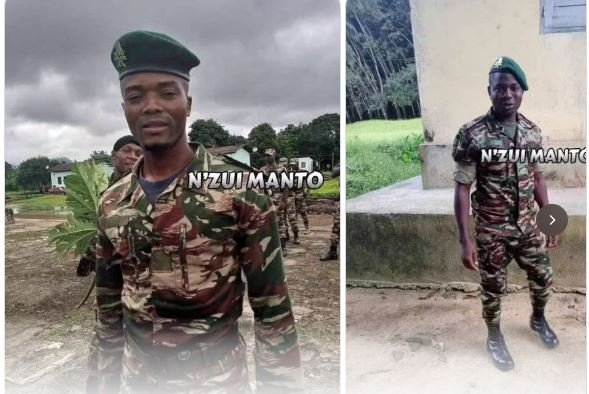
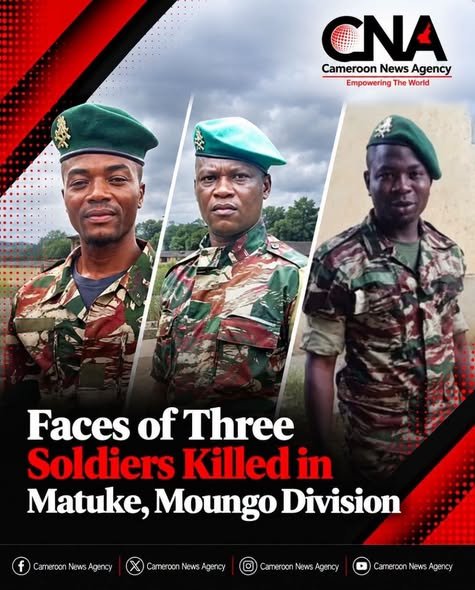
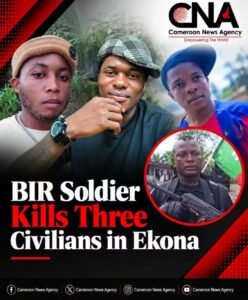
The images before us are not photographs of victory. They are portraits of collective failure: three civilians reportedly killed in Ekona, and three soldiers reportedly killed in Matuke. Six Cameroonian families are grieving. Six lives have been lost. What constitutional question did these deaths resolve? What political objective did they achieve? Who will be killed next?
Nobody is safe in Cameroon.
Government officials cannot freely return to their villages because nobody is safe.
Military personnel cannot walk freely through communities or relax in restaurants because nobody is safe.
Separatist fighters cannot move openly through towns or sleep peacefully in their family homes because nobody is safe.
During lockdowns and ghost towns, civilians cannot freely go to the market, hospital, farm—or sometimes even a nearby pit toilet—because nobody is safe.
When public officials fear their own villages, soldiers fear restaurants, fighters fear their own homes and civilians fear the road to the hospital, who can honestly claim to be winning this war?
Who benefits from this catastrophic insecurity, instability and criminality? Certainly not the soldiers being buried, the fighters dying in the bushes, the civilians murdered in their homes, the children kept out of school or the families driven into poverty and exile.
A constitutional crisis requires a constitutional and political settlement—not endless bloodshed. Dialogue is necessary, but dialogue without a defined objective, genuine negotiation and enforceable constitutional reform will become another ceremony of speeches and photographs.
Cameroon’s authorities are under a moral and institutional obligation to call for immediate, inclusive negotiations that bring together the country’s sons and daughters—Government representatives, Anglophone leaders, separatist representatives, political parties, civil society, traditional authorities, women, young people and the diaspora.
The objective must be clear: to negotiate and draft a genuinely federal Constitution that acknowledges Cameroon’s history and protects the distinct legal, educational, linguistic and cultural heritage of the North-West and South-West Regions while establishing a fair and workable relationship among all components of the country.
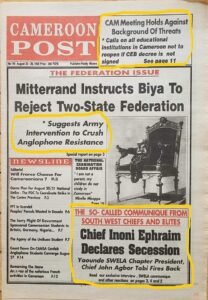
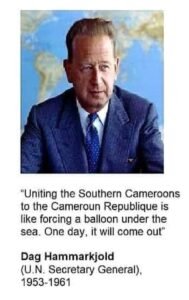
Cameroon’s present constitutional instability has deep historical roots. The Constitution of 4 March 1960 was strongly influenced by the French constitutional model. It was followed by the 1961 Federal Constitution, the abolition of the federation in 1972 and repeated constitutional changes thereafter. This history cannot simply be erased or suppressed by force.
If the constitutional foundation is unstable, manipulated or repeatedly altered without sufficient national consent, how can political relationships built upon it remain stable?
If trust is repeatedly violated, how can unity survive?
If citizens experience corruption, injustice, poverty, unemployment and inequality, how long can the State expect coercion alone to preserve peace?
And if every call for constitutional reform is answered with bullets, arrests, ghost towns or intimidation, what peaceful avenue remains for resolving legitimate grievances?
The answer is becoming painfully obvious: there is no military solution. The only credible way forward is an immediate ceasefire, protection of civilians, confidence-building measures, inclusive negotiations and a binding constitutional settlement accepted by the people.
Federalism is not the destruction of Cameroon. Properly negotiated, it can be the constitutional instrument that saves Cameroon—by replacing domination with partnership, suspicion with guarantees and forced unity with voluntary coexistence.
We must stop asking how many more soldiers, fighters and civilians must die before negotiations begin. We must ask why serious negotiations have not already begun.
Either Cameroonians end this conflict now—or, through fear, silence and political failure, this conflict may eventually end the Cameroon we know.
ENOUGH BLOODSHED. LET CAMEROON NEGOTIATE ITS FUTURE.
Dr. David Makongo