
Cameroon Cocoa Producers Receive Record 1.5 Trillion CFA Francs in 2023-2024 Campaign
The 2023-2024 Cocoa Campaign in Cameroon: A Prosperous Season for Producers
The cocoa campaign of 2023-2024 in Cameroon has marked a significant milestone in the agricultural sector of the country. With a staggering remuneration of nearly 1,500 billion CFA francs for producers, this season has been a testament to the resilience and hard work of the Cameroonian cocoa farmers.
Cameroon’s cocoa sector has seen a remarkable surge in prices, reaching a record high amid a global shortage of the commodity. On March 5, 2024, producer prices per kilogram soared to an unprecedented CFA4,225, setting a new national and global record. This achievement is attributed to several factors, including favourable international market dynamics and the consistent enhancement of the nation’s cocoa bean quality.
The Minister of Trade, Luc Magloire Mbarga Atangana, acknowledged this milestone, highlighting the international market situation, which includes projected production declines in leading cocoa-producing countries like Côte d’Ivoire and Ghana due to climate-related issues and ageing plantations. The global cocoa production for the 2023-2024 season is forecasted to decrease by 11 per cent, leading to a market deficit of 374,000 tons by September 2024. This scenario has contributed to the surge in cocoa prices, with Cameroon’s cocoa being the best-performing agricultural commodity since the beginning of 2024, gaining 56.4 per cent.
The increase in remuneration for producers is also a result of collective sales strategies, which enhance their bargaining power against buyers. This approach fosters competition among buyers, leading to better prices for producers. The robust demand for Cameroon’s distinctive red-brown cocoa beans has further driven up prices during the 2023-2024 campaign.
Moreover, the country has witnessed the establishment of three new local processing plants in less than three years, with combined capacities approaching 100,000 tons. This development not only supports the local economy but also ensures that more of the value generated from cocoa remains within the country.
The National Cocoa and Coffee Board (NCCB) has played a pivotal role in this success, providing support and resources to the farmers. The official launching of the 2023/2024 cocoa season was marked by a solemn ceremony, reflecting the government’s commitment to the agricultural sector.
Cameroon, currently the 4th largest cocoa-producing country in the world and the 3rd largest in Africa, has set an ambitious target to lift its production to 640,000 MT per year by 2030. Cocoa plays a crucial role in the country’s economy as it is the second-largest export product, and the success of this campaign is a promising sign for the future of Cameroonian agriculture.
The 2023-2024 cocoa campaign in Cameroon is not just about the impressive figures; it’s about the positive impact on the lives of thousands of cocoa farmers and their communities. It’s a story of progress, sustainability, and hope for a brighter future in the agricultural landscape of Cameroon.
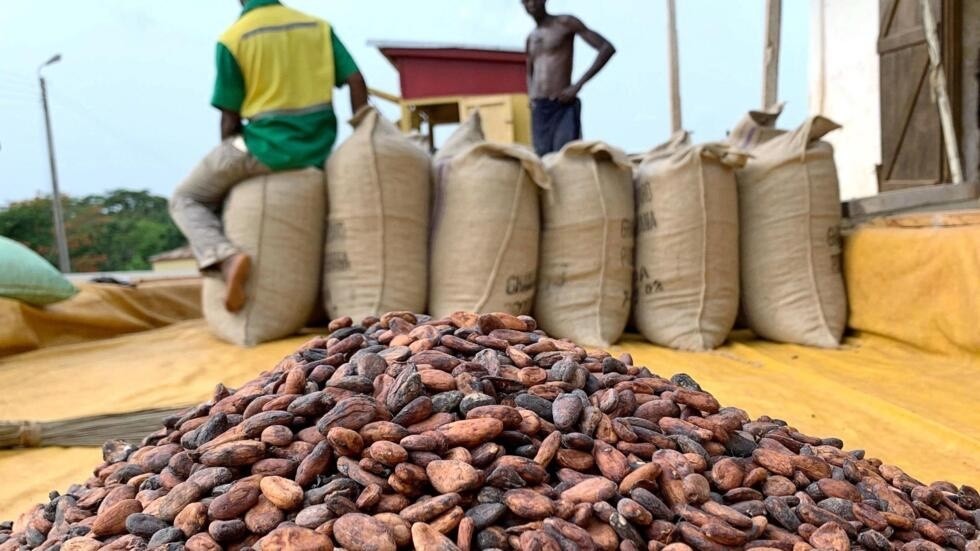
Cameroonian Minister of Commerce (Mincommerce), Luc Magloire Mbarga Atangana, has issued forecasts on the remuneration of cocoa producers at the end of the 2023-2024 cocoa season, an estimated amount of 1,500 billion CFA francs. This was during an information meeting chaired by the Minister on July 18, on the challenges of European Union (EU) Regulation 2023/1115 on deforestation and forest degradation in trade (RDUE) for Cameroon. The said session was held in the presence of the heads of the relevant ministerial departments and representatives of the European Union, led by Jean-Marc Chataigner, head of the European delegation to Cameroon.
In its presentation, Mincommerce relied on the favourable context of the cocoa price in Cameroon. Indeed, in the country, the price per kilogram of beans is 5,156 CFA francs according to the latest updates from the National Cocoa and Coffee Office (ONCC) dated July 18, 2024. Thanks to this price [which is the highest on the continent] and the volume of cocoa exported during the 2023-2024 campaign, approximately 300,000 tons, Mincommerce estimates that the remuneration that will be paid to producers as part of this campaign should reach 1,500 billion CFA francs. “With the current price level, which I would put at around 5,000 CFA francs per kilogram of cocoa, that is to say 5 million CFA francs per tonne, and for an exported production of 300,000 tonnes, this represents a remuneration paid directly to the producer, over a single campaign, of the order of 1,500 billion CFA francs,” he stressed in his presentation.
To the great delight of producers, this remuneration would be up 510% compared to the 2 previous campaigns [2021-2022 and 2022-2023] where it stood at 295.1 billion CFA francs for an average cost of 1,000 CFA francs/kg of cocoa beans. If proven, the Mincommerce forecast would delight producers of brown gold who have participated in the valorization of local cocoa through the practice of improved harvesting techniques with the aim of making Cameroonian cocoa a cocoa of excellence sold internationally to the great displeasure of the world’s leading producers, notably Côte d’Ivoire and Ghana.
This onerous remuneration comes at a time when the EU wants to restrict access to its vast market of over 500 million consumers to producer countries that do not adhere to the EUDR, which will come into force on 30 December. At this level, the stakes for Cameroon are not insignificant because most of its cocoa and coffee exports are sold on the European market. “78% of Cameroon’s cocoa exports and 68% of its coffee exports are destined for the European market. Our producers deserve a premium rather than a restriction on market access, given our shade-grown production system,” said Luc Magloire Mbarga Atangana. In order to maintain its access to this market, Cameroon faces three challenges: ensuring product traceability; implementing a “zero deforestation” policy; and complying with the legality requirements imposed by the EU. According to the minister, Cameroon is not far from this given that the vast majority of producers practice agroforestry in cocoa and coffee growing.